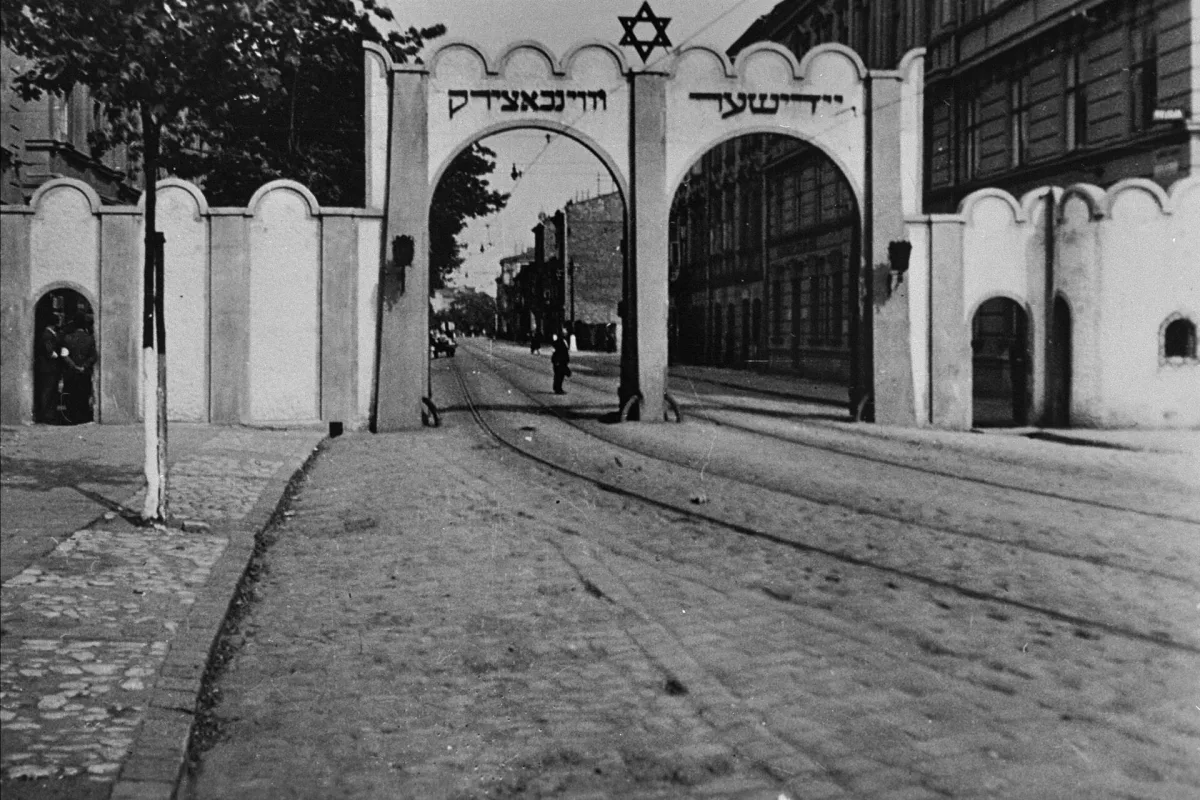
A closed district for the Jewish population in Podgórze, established in March 1941 and liquidated in March 1943.
The Kraków Ghetto was a closed district for the Jewish population, established by the German occupation authorities in Podgórze in March 1941 and liquidated in March 1943. Today its history is recalled by fragments of the wall, Ghetto Heroes Square and a museum in the former pharmacy.
The ghetto was established by an order of Otto Wächter, governor of the Kraków district, of 3 March 1941. It was closed on 21 March 1941. According to the Jewish Historical Institute it covered about 20 hectares, and at least 15,000 people had to live in buildings with a little over three thousand habitable rooms. The Museum of Polish History states that there were 320 residential houses in the ghetto. The area was surrounded by a wall topped in the shape of Jewish gravestones, and four guarded gates were designated. Among them was the gate at Zgody Square, today Ghetto Heroes Square.
In 1942 the Germans carried out two deportation actions in the ghetto, and its area was reduced. The final liquidation began on 13 March 1943. The next day a selection was carried out, and according to the Jewish Historical Institute about 2,000 people were murdered in the streets. The residents judged fit for work were taken to the camp in Płaszów, and from there some were deported to Auschwitz.
Fragments of the wall have survived on Lwowska and Limanowskiego streets. On Ghetto Heroes Square, the former Zgody Square, stands the former Eagle Pharmacy (Apteka Pod Orłem), run during the war by Tadeusz Pankiewicz. According to the Museum of Kraków, it was a meeting place and refuge for people confined in the ghetto. The permanent exhibition in the building that houses the pharmacy was opened on 1 July 2017 by the Museum of Kraków. Nearby is Oskar Schindler's Enamel Factory, with an exhibition on occupied Kraków.

Be the first! Add a comment.
You need to log in to add a comment.
Log in