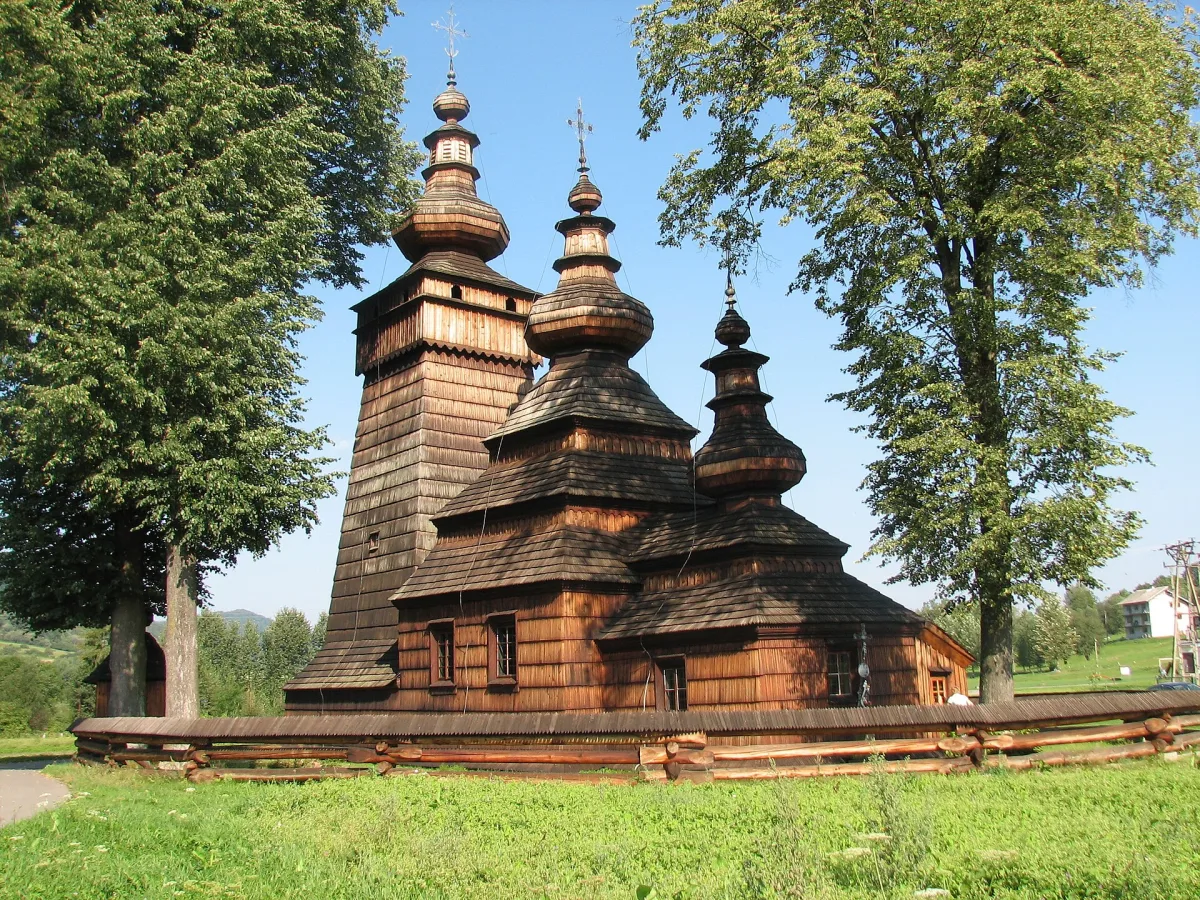
A wooden Lemko tserkva from the second half of the 17th century, on the UNESCO list, today a branch church of a Roman Catholic parish.
The Tserkva of St Paraskeva in Kwiatoń is a wooden church (tserkva, a wooden Eastern-rite church) built in the second half of the 17th century, regarded as one of the best-preserved examples of Lemko church architecture in Poland. Since 2013 it has belonged to the group of wooden tserkvas of the Carpathians inscribed on the UNESCO World Heritage List.
The log-built structure has a plan made up of three squares: the chancel, the nave and the narthex, each under a separate roof. It represents the north-western type of Lemko tserkva and is sometimes regarded as its model and most beautiful example. The tower has sloping walls and a post construction, and the whole tserkva, both walls and roofs, is clad in shingles. The roofs are tented, broken twice, with finials and lanterns. The year 1700 is often given as the date of construction, and the tower was added in 1743. The entry in the heritage register dates from 1986.
The polychromy was painted in 1904 by Michał Bogdański, the same artist who created the iconostasis separating the chancel from the nave. The walls show columns, cornices, angels, a scene of the Transfiguration and the evangelists. Inside there are three altars: the main one from the 19th century and two side ones with icons. The music choir is decorated with a carved arcaded balustrade. A stone holy water stoup from 1750 has also survived, and the sacristy holds an epitaphios (burial shroud).
The main body was repaired in 1811, 1904 and 1967 and in the 1990s, and the tower in 1863, 1911, 1928 and 1967, also in the 1990s. In 2011 the shingle covering was cleaned.
The tserkva is one of eight Polish entries on the 2013 list, which includes 16 wooden tserkvas of the Carpathian region in total, from Poland and Ukraine. The listing meets criteria III and IV.
The building was constructed by the Lemkos as a Greek Catholic tserkva. Operation Vistula in 1947 affected about 140,000 people from south-eastern Poland, including Lemkos, who were forcibly resettled. The tserkva in Kwiatoń was then taken over by the Roman Catholic Church. Today it is a branch church of the parish of Our Lady of Perpetual Help in Uście Gorlickie.
Other tserkvas of the region are the tserkva in Regietów and the tserkva in Przysłup. A walk leads to the Kozie Żebro nature reserve, and by the water you can stop at Lake Klimkowskie.

Be the first! Add a comment.
You need to log in to add a comment.
Log in