
The order of March 1941
The Germans occupied Kraków on 6 September 1939. According to the Jewish Historical Institute (ŻIH), discriminatory regulations against Jewish residents began to apply as early as that month, a Jewish Council was appointed, and from November Jews had to wear the Star of David on their arm. ŻIH states that in 1939 about 80 thousand Jews lived in the city, and that in 1940 this number fell considerably after an order to resettle to the Lublin district.
The order establishing a “Jewish residential district” was issued on 3 March 1941 by Otto Wächter, governor of the Kraków district. The district was designated in Podgórze, on the southern side of the Vistula. According to the Museum of the History of Poland, Jews were to move there by 20 March, and non-Jewish residents of the area had to move out to other parts of the city. ŻIH states that the ghetto was closed on 21 March 1941.
Boundaries, the wall and the number of residents
The ghetto covered about 20 hectares. The numbers of people confined in it differ depending on the source:
- ŻIH: at least 15 thousand people in buildings with just over three thousand living rooms,
- Museum of the History of Poland: about 15 thousand residents in 320 habitable houses,
- Museum of the Warsaw Ghetto: nearly 11 thousand at the start, and at its peak, before June 1942, about 20 thousand.
The area was enclosed by a wall topped in the shape of Jewish gravestones. Four guarded gates led into it, and the main one bore a Star of David and the inscription “Jewish residential district” in German and Yiddish. Leaving beyond the wall without a pass was punishable by death. ŻIH gives the date 15 November 1941, while the Museum of the Warsaw Ghetto writes of October 1941. According to ŻIH, the ghetto had two hospitals, a boarding house and a prison, and two “Aryan” tram lines ran through its territory.
The Museum of the Warsaw Ghetto also describes attempts to recreate social life: religious and aid institutions, health facilities, orphanages, a care home for the elderly, and concerts whose proceeds went to support self-help institutions. The Museum of the History of Poland points to poor housing conditions and malnutrition, which favoured infectious diseases.
Deportations in 1942
As part of Operation Reinhard, in 1942 the Germans carried out two deportations to the Bełżec extermination camp. ŻIH states that from 1 to 6 June about 5,000 people were deported to Bełżec or murdered in the streets, and that in October about 5,000 people were deported to Bełżec. The Museum of the Warsaw Ghetto gives a total of 10-12 thousand people deported in both actions. After the deportations the area of the ghetto was reduced. After 6 December 1942 it was divided into part A, where those who worked lived with their closest families, and part B for the rest.
Liquidation on 13 and 14 March 1943
The final phase of liquidation began on 13 March 1943. According to the Museum of the Warsaw Ghetto it was led by SS-Sturmbannführer Wilhelm Haase, and the residents of part A, about 8 thousand people, were marched to the camp in Płaszów. They were forbidden to take children under the age of fourteen. ŻIH states that about 10 thousand people remained in the ghetto at that time.
On 14 March part B was liquidated. Those unfit for transport, among them small children, the elderly and the sick, were murdered on the spot. The number of these victims is given differently: ŻIH writes of about 2,000 people murdered in the streets of the ghetto, and the Museum of the Warsaw Ghetto of more than 700 people murdered during the liquidation and in the following days of clearing the area. According to the same museum, at least 8 thousand people fit for work were confined in the camp in Płaszów, and about 2 thousand were deported to Auschwitz-Birkenau, where most died. ŻIH notes that Jews sent to Płaszów were subsequently deported to Auschwitz.
ŻIH records that Amon Göth and Wilhelm Haase were tried after the war and executed in Kraków.
Traces of the ghetto in Podgórze
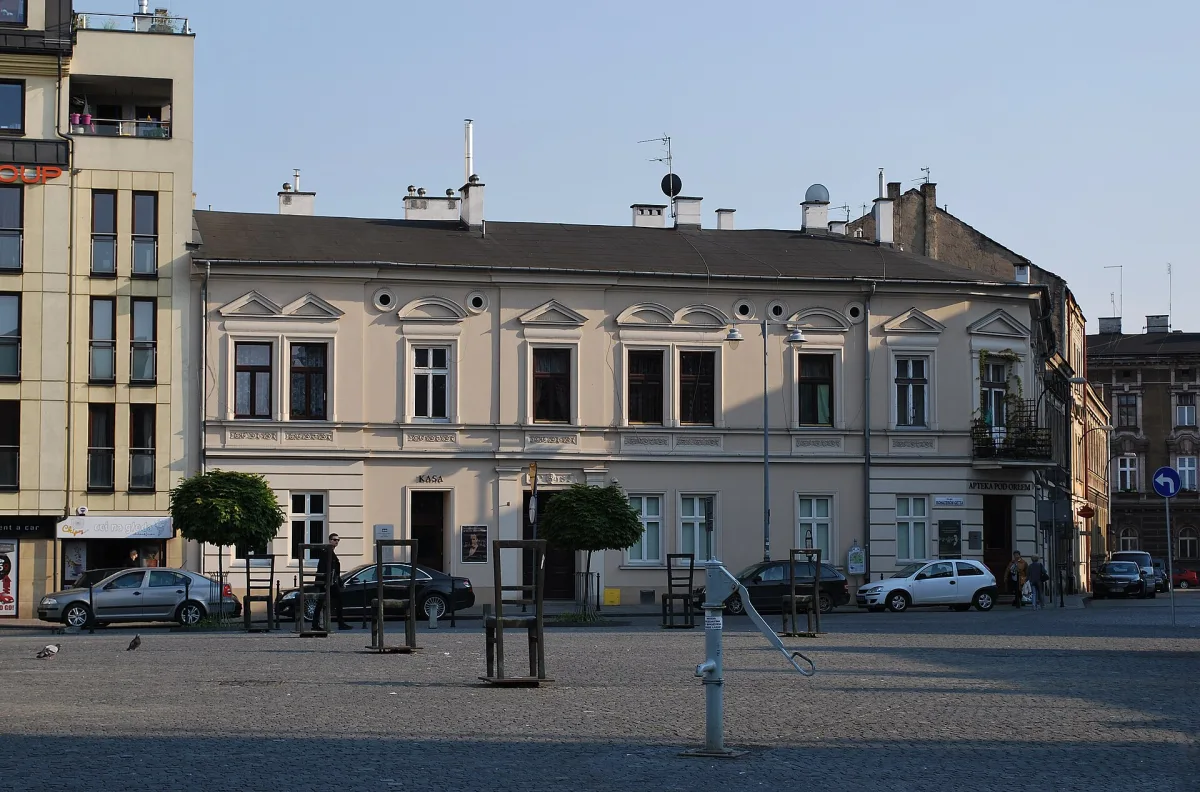
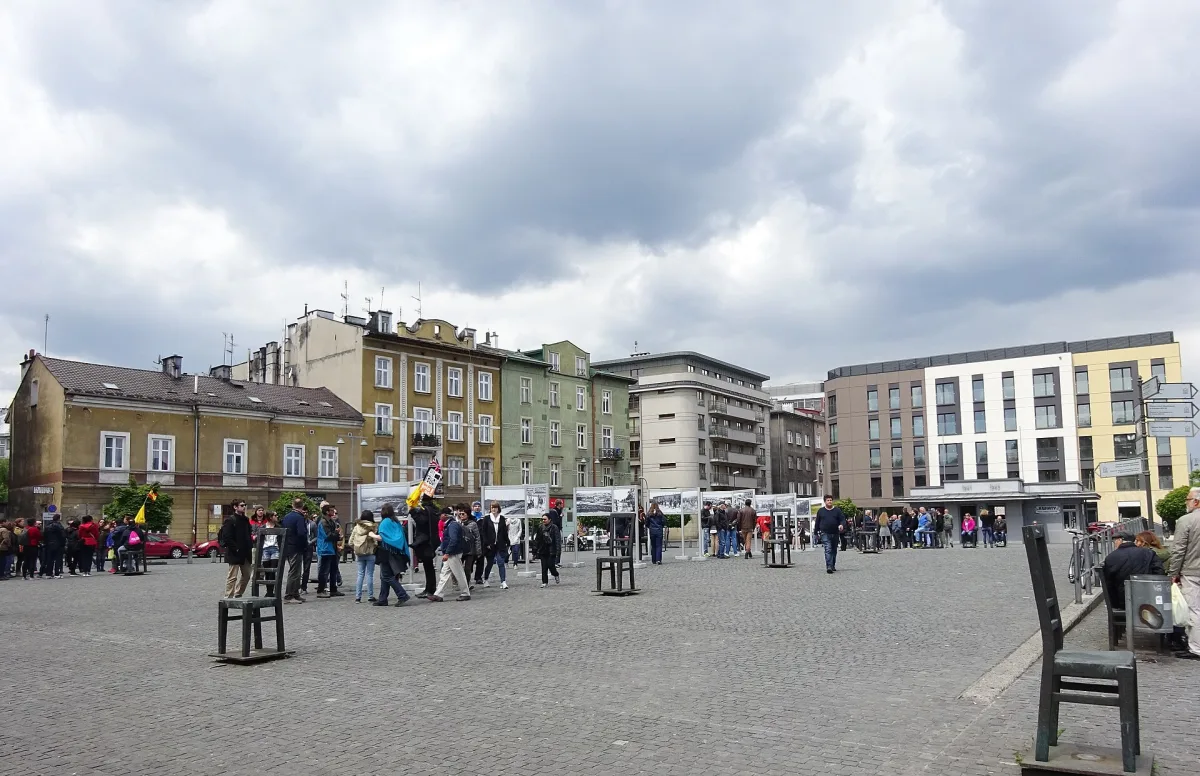
Two fragments of the wall have survived to this day, at 25-29 Lwowska Street and 62 Limanowskiego Street. The former Zgody Square, today Ghetto Heroes Square, was an assembly point before the deportations. It is commemorated by a monument made up of empty chairs. The square also holds the former Eagle Pharmacy, run during the ghetto period by Tadeusz Pankiewicz, now a branch of the Museum of Kraków. The City of Kraków announces an annual March of Remembrance in honour of the victims of the Holocaust. Further information on the history of the site is given in the entry on the Kraków ghetto.
Be the first! Add a comment.
You need to log in to add a comment.
Log in