
A marshal, a pope and an order from Tuscany
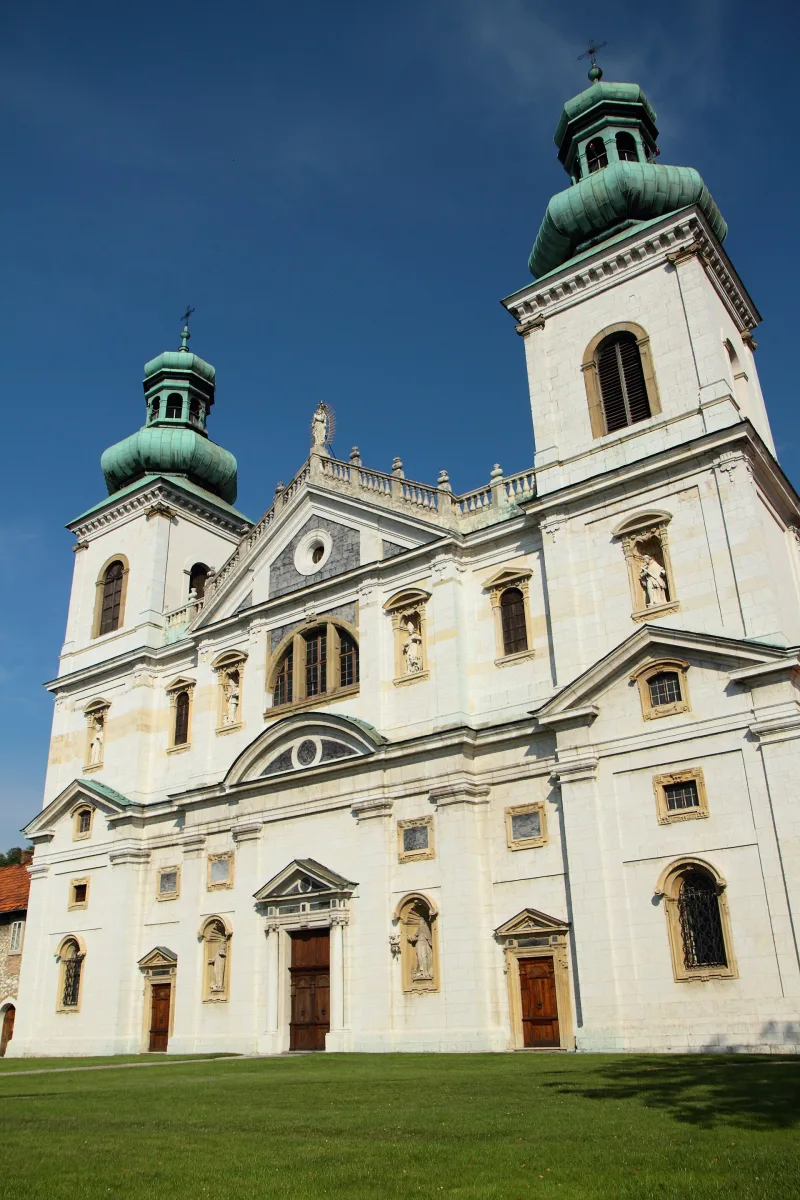
On Srebrna Góra (Silver Hill), in the south-western part of Wolski Forest, stands a Baroque church with a Camaldolese hermitage. A description of the monument itself can be found in the entry Church of the Assumption of the Blessed Virgin Mary at Bielany, and this text tells about the people who founded it and about the rule by which the community lives here.
The monks were brought in by the Grand Crown Marshal Mikołaj Wolski. As an envoy of King Sigismund III to Pope Clement VIII he stayed in Italy and there met the Camaldolese, who undertook to send several monks to Poland if he built them a monastery and provided funds for their upkeep. The year of arrival is given differently: the hermitage website writes of 1602, and Wikipedia of 1603. Building work began in 1604, the church and hermitage were built in 1609-1630, and the consecration took place in 1642.
The hill had earlier belonged to the castellan Sebastian Lubomirski, who at first did not want to give it up. According to a tradition repeated by the order's website and Wikipedia, in gratitude Wolski gave him the silver tableware from the feast at which the matter was settled, and this was said to be the origin of the name Srebrna Góra. The name Bielany comes from the white habits of the monks. This is an oral tradition, not a document, so we treat it as a story attached to the place.
Who the Camaldolese are and by what rule they live
The order originates from Camaldoli in Tuscany, where St Romuald founded the first hermitage. Wikipedia gives the year 1012 or 1027, while the Camaldolese website writes of 1012. The name of the order comes from the place Camaldoli, that is, as tradition has it, from a field belonging to a nobleman named Maldolus. The Camaldolese remain within the Benedictine family and base their life on the Rule of St Benedict, but combine it with the eremitical form. In Tyniec, in the south-western part of Kraków, lives a community of Benedictines, about which we write separately in the entry Benedictine Abbey in Tyniec.
The Camaldolese at Bielany belong to the Congregation of Camaldolese Hermits of Monte Corona, which was founded in 1520 by Blessed Paolo Giustiniani on Monte Corona. According to the order's website it is a contemplative institute that does not undertake pastoral work. Each monk lives in a separate house, a hermitage, with a small garden. They meet together for Mass, for the liturgy of the hours and several times a year for a meal in the refectory, and eat the other meals alone. The day begins at 3.30, the dress is a white habit with a hood, scapular and belt, and according to the order's website the monks keep silence, have no radio or television and do not eat meat. Work, prayer, reading, contemplation, penance, fasting and solitude are meant, as the Camaldolese themselves write, to serve full union with God.
The order's website states that the hermitage on Srebrna Góra is the only Camaldolese hermitage in Poland to have existed continuously since the 17th century. Wikipedia adds that two such places operate in Poland: Bielany and Bieniszewo near Konin.
Enclosure and the entry of women
The whole area of the hermitage is surrounded by a stone wall, which according to the order's website ensures strict enclosure for the monks. The complex includes the church, two courtyards, a chapter house, a refectory and a guest house. Wikipedia describes that to the east of the church stretches a zone of silence and solitude: a large rectangular garden, divided into small gardens, with rows of hermitages.
The Wikipedia entry on the church states that the monastic rule admits only men to the monastery, and women have access on only 12 designated days a year, on selected Marian and Easter feasts, and it cites the order's website for this. Appropriate dress is, according to it, required for the church. The days and rules of entry are set by the monastery, and they must be checked with it before travelling.
The church, stucco and crypt
For the first seven years the building was directed by Walenty von Säbisch. After a construction disaster and the collapse of part of the church, direction was taken over by the Italian architect Andrea Spezza, who brought the work to completion according to his own plans. The hermitage website attributes the church's pediment to Spezza. The church has three towers, and Wikipedia draws attention to the unusual placement of the third. The rich stucco of the interior comes from the workshop of Giovanni Battista Falconi, in the Royal Chapel hang paintings by Tommaso Dolabella, and in the chancel there is a painting of the Assumption, which Michał Stachowicz painted after a fire. The hermitage website also singles out a 17th-century image of Our Lady, Lady of the Camaldolese, the work of the Camaldolese monk Fr Venantius of Subiaco.
Under the chancel there is a chapel and a crypt. Wikipedia describes that in its walls the remains of deceased monks are walled in for a hundred years, after which, following exhumation, they go to a collective tomb. Mikołaj Wolski, dressed in a Camaldolese habit, was buried in the church, by the great door.
Kings, a pope and the surroundings of Srebrna Góra
The hermitage website lists among the monastery's guests Władysław IV Vasa, John Casimir during the Swedish Deluge and John III Sobieski before the expedition to Vienna. Pope John Paul II visited Srebrna Góra on 19 August 2002. The sources attribute differently the famous remark about the Camaldolese as Kraków's "lightning rod": the order's website cites it as the words of Cardinal Karol Wojtyła, and Wikipedia as words of the pope spoken in 2002.
The hill in question is Srebrna Góra, above which the monastery rises. Right next to it stands Battery FB 35 Srebrna Góra, an Austrian heavy artillery battery of the Kraków Fortress. On the southern slopes lies the strict nature reserve Bielańskie Skałki, and nearby Fort Bielany, the last fort of the Kraków Fortress. All of it is surrounded by Wolski Forest, in which there are also the Pustelnik hill and the Kraków Zoo.
Be the first! Add a comment.
You need to log in to add a comment.
Log in