
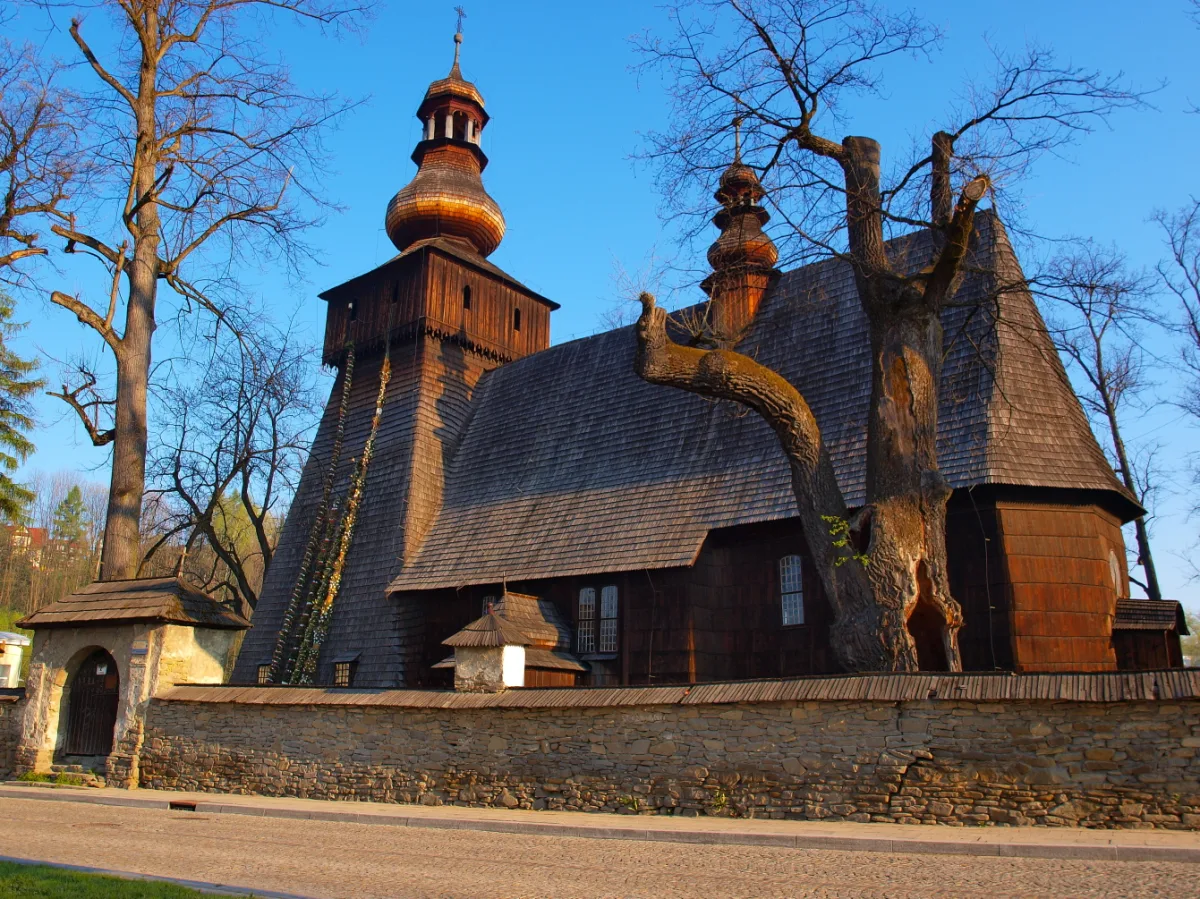
Szczyrzyc lies in Limanowa County, at the foot of the Island Beskids, and its Cistercian abbey is, according to the history of the order, more than seven centuries old. Wikipedia calls it the only continuously existing Cistercian monastery in Polish lands. Its beginnings, however, go back to a place we know today for quite a different reason: Ludźmierz in Podhale.
From Ludźmierz to Szczyrzyc
The founder was Teodor Cedro of the Gryf coat of arms, voivode of Kraków, also called Teodor Gryfita. He gave the Cistercians from Jędrzejów extensive lands in the Podtatrze region, which they were to colonise. In 1234 the monks founded their monastery there, in Ludźmierz. Today the village is home to the Marian shrine in Ludźmierz, and the cult of the Mother of God, close to the Cistercians, developed in both places: first around the figure of Our Lady of Ludźmierz, then around the image of Our Lady of Szczyrzyc.
Around 1243, as Wikipedia states, the monks moved the seat of the abbey to Szczyrzyc. The reason is not known exactly. They were probably put off by the harsh climate of Podhale or the infertile soil. Perhaps it was also connected with raids by Tatars and brigands, which threatened monasteries in those areas. The year 1243 is therefore a conjecture, while 1234 is the founding date from which the age of the abbey is counted.
Monks who developed the region
The Cistercians of Ludźmierz and Szczyrzyc did more than pray. According to the same study, they founded Nowy Targ and built a defensive castle in Szaflary. They turned wild land into fields, regulated riverbeds, built bridges, mills and breweries, and planted orchards and set up apiaries. They also taught young people crafts, especially those connected with farming. This is a typical picture of an order that settled in wilderness areas and organised an economy around itself.
The partitions, the war and the schools
During the partitions the Cistercians of Szczyrzyc lost their land. They were forbidden to accept novices, but were allowed to found a four-class elementary school for village children. Among its pupils was the writer Władysław Orkan, and his ties with the region are told in the Władysław Orkan Museum in Rabka-Zdrój.
During the German occupation the abbey gave shelter to many refugees from various parts of Poland. Secret teaching was carried out there, and its continuation from 1945 was the Private Grammar School of the Cistercian Fathers in Szczyrzyc. The authorities closed it in 1955. For valour during the Second World War the abbey was awarded the Virtuti Militari Cross. After the political transformation the Cistercians bought back part of the land, intending to continue the order's agricultural traditions.
The church, the monastery and the Abbot's House
The complex consists of a masonry church of the Assumption of the Blessed Virgin Mary and St Stanislaus the Bishop from 1620, rebuilt in the 18th and 19th centuries. The high altar holds the image of Our Lady of Szczyrzyc. Adjoining the church is the monastery, a complex of 17th-century buildings arranged in a square around a cloister garth. Part of the buildings, including two portals, altar tables and a fragment of the cloister walks, comes from the first abbey, which was destroyed by fire. In 1831 a wing and a wooden bell tower with an onion-shaped dome were added on the east side.
Among the most valuable monuments of the monastery are a 15th-century crucifix, a 16th-century stone holy water stoup, and paintings of saints from the 17th to 19th centuries. In 1938 the icon of Our Lady of Wystycze, regarded as miraculous, was brought here from the former Cistercian church in Wystycze.
The masonry Abbot's House from the 16th century, formerly a granary, is decorated with a stone portal bearing the Korczak coat of arms. It houses the Monastery Museum. Its collections include parchment manuscripts, the 15th-century Cross of the Good Journey, a collection of chalices and swords, and more than 4,000 stones, among them a fragment of a meteorite. One of the rooms is devoted to Władysław Orkan and contains the manuscripts of three of his letters to his sister Maria.
Monastery beer
The history of the Cistercians is linked with brewing. Old chronicles of the abbey mention a drink made from roasted grain, chicory and hops, a low-alcohol beer brewed to a special recipe. After the war the brewery was nationalised and cheap, mass-produced beer was made in it. The monastery regained the brewhouse in 1993, but did not return to the traditional recipe, which was lost in the archives. In 1997 the brewery was closed because of debt, and the Ministry of Culture recognised it as a historic monument and halted the auction. In March 2003 the recipe was found in the monastery's notes and the Cistercian beer returned to the market. The history of brewing is described in one of the museum rooms, with a collection of labels from the gifts of private collectors.
The legend of the devil's gold
The monastery is linked with a tale of a fiddler who, returning from a wedding, met the devil and received a sack of gold for playing at the wedding. Frightened that the treasure would betray his pact, he gave the money towards building the monastery. The furious devil wanted to hurl an enormous boulder onto the abbey, but the monks entrusted themselves to the care of the Mother of God, and the stone became so heavy that the devil abandoned it three kilometres from the monastery. The legend points to a boulder in the village of Krzesławice, with which an abandoned hermitage is also connected, inhabited by the last hermit until 1992. This is a tale, not a historical fact.
Szczyrzyc today in the Cistercian family
The abbey today oversees priories in Gdańsk-Oliwa, Henryków and Willow Springs in the United States, as well as a branch in Jodłownik, where the new church of the Nativity of the Blessed Virgin Mary stands. A full description of the complex can be found in the entry for the Cistercian Abbey in Szczyrzyc.
Be the first! Add a comment.
You need to log in to add a comment.
Log in