
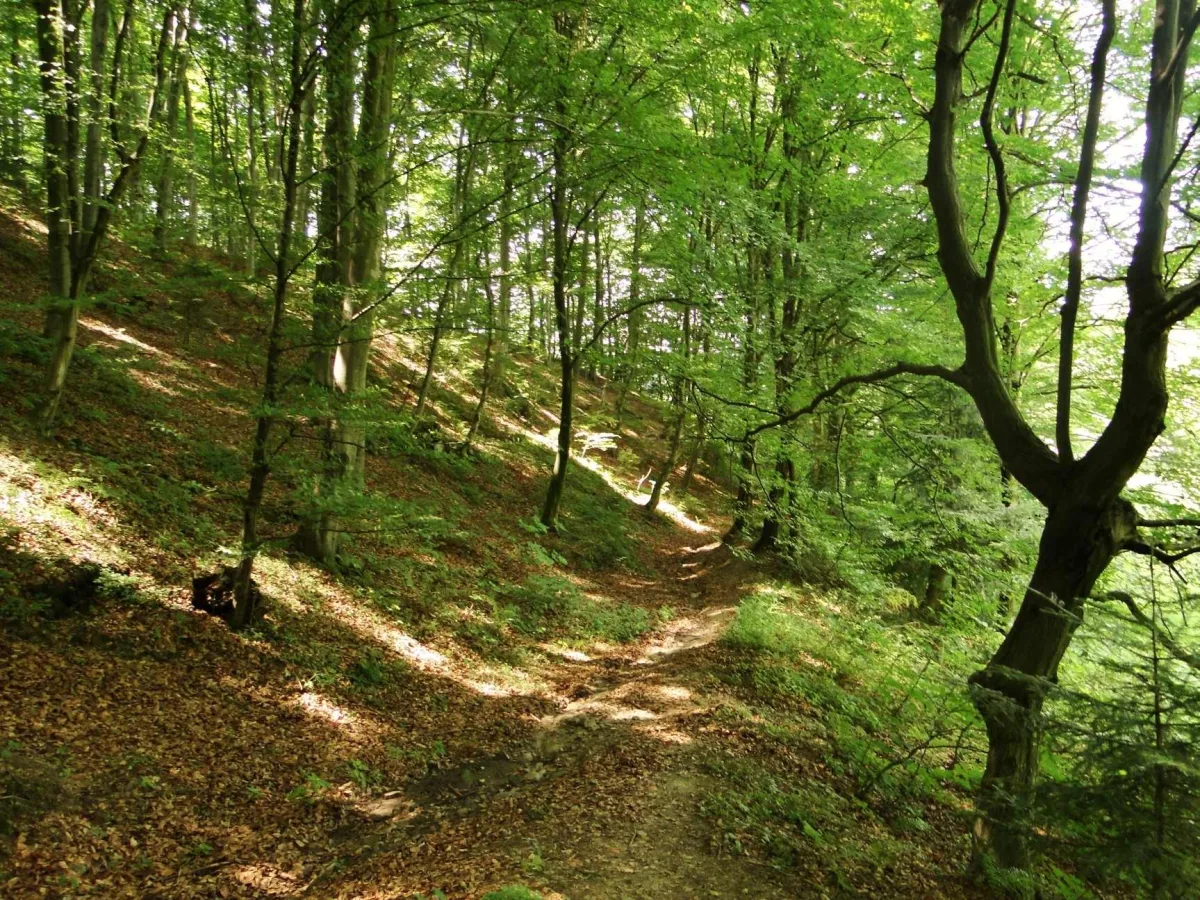
A few hundred metres from the market square in Ciężkowice, in the forest on the slopes of the Skała hill, stand sandstone outliers shaped like pulpits, clubs and mushrooms. The tallest of them are about 14 metres high. The whole is called the Petrified Town (Skamieniałe Miasto) and is a nature reserve of inanimate nature in the Ciężkowice Foothills.
The reserve: from natural monument to nature reserve
The rocks lie on the right bank of the Biała River, within the town of Ciężkowice and the Ciężkowice-Rożnów Landscape Park. The need to protect them was already being discussed before the Second World War. The area was then a treeless communal pasture, and the rocks were clearly visible, but in several places quarries were operating: the stone went into the embankments of the nearby railway line and into building houses.
According to Wikipedia, the outliers were declared a natural monument in 1931, and in 1974, by order of the Minister of Forestry and the Timber Industry, the whole area was given the status of a nature reserve. The area is 15.11 hectares, although the founding act gave 15.01 hectares. The reserve consists of one large enclave and 11 smaller ones separated by narrow strips of forest. A buffer zone has been designated around it, and in the rocks themselves there are many small caves and shelters used by bats.
What the rocks are made of and where they came from
The outliers are built of coarse-grained Ciężkowice sandstones and conglomerates, belonging to the Silesian Nappe of the Outer Carpathians. Wikipedia states that this sandstone formed through sedimentation about 58-48 million years ago on the floor of the Tethys Ocean. It is therefore a marine sediment that was later uplifted and exposed.
The rock forms were sculpted by weathering. In the post-glacial period the planes of joint fractures were the most exposed, so the most resistant fragments survived and became isolated crags. Surface gravitational movements and rockfalls also played a part, through which some outliers shifted and tilted from the vertical, and in some places so did the flow of water and the Biała River. The process is still going on. Sedimentary and tectonic structures are easy to see in the rocks, which is why the reserve also serves as an educational site. Variegated shales of reddish colour with grey-green streaks also occur here.
The legend and the names of the rocks
The name of the reserve comes from a legend. The tale says that the rocks are the houses of a town that turned to stone together with its inhabitants for their wicked life. It is a folk story, not information about the history of this place, which formed in the way described above. Most of the rocks have their own tales, and some have more than one.
The names of the rocks refer to shapes or to people: Piramidy (Pyramids), Grzybek (Little Mushroom), Orzeł (Eagle), Czarownica (Witch), Ratusz (Town Hall), Warownie (Strongholds), Baszta Paderewskiego (Paderewski's Tower). The outcrop by the road was named Grunwald in memory of the 500th anniversary of the battle and of seven knights from the area who took part in it. The tower bears the name of Ignacy Jan Paderewski, who had a manor house in nearby Kąśna Dolna in 1897-1903. In the market square stands the Paderewski Bench.
Visiting
A blue hiking trail leads through the reserve. A visit can begin at the car park about a kilometre from the centre, by the Tarnów - Ciężkowice - Gorlice road. Right beside it are the Czarownica and Ratusz rocks, reached by a viaduct over the road, and further on Grunwald and the clearing called Wąwóz Harcerzy (Scouts' Gorge). The trail crosses Lisi Wąwóz (Fox Gorge), passes the Skałka z Krzyżem (Rock with a Cross) and reaches the Ciężkowice Gorge. In the gorge, on the eastern side of the reserve, is the Ciężkowice Waterfall, also called the Witches' Waterfall, with a total height of 14 metres.
In the past people climbed here with ropes, mainly on Ratusz, Czarownica and Warownie. Since the creation of the reserve climbing has been forbidden, and the old belay rings were removed. Bouldering is also forbidden, although it is practised on many rocks.
In Ciężkowice, which received its town charter in 1348, lost it in 1934 and regained it in 1998, other places for a walk have arisen around the rocks. Next to the reserve lies the Spa Park with hydrotherapy facilities based on the Kneipp method, and in the centre the Natural History Museum with a collection of birds, insects and hunting trophies.
Be the first! Add a comment.
You need to log in to add a comment.
Log in