
In the Middle Ages the Dunajec and its tributary the Poprad were trade routes to Hungary, and castles were built where the river forced merchants to slow down: in gorges, on rocks above fords and at the border. From the Pieniny Mountains to the area around Tarnów, a dozen or so strongholds have survived. Some are rebuilt, others are barely a rampart and a few stones. This text leads from the upper river downstream: from Lake Czorsztyn, along the Poprad, to the lower Dunajec River.
The Pieniny Mountains and Lake Czorsztyn
Two castles stand facing each other on the shores of Lake Czorsztyn, a reservoir created in 1970-1997. According to Wikipedia it is about 9 km long and lies in the Nowy Targ Basin, between the Pieniny Mountains and the Gorce. Before the water was dammed, Niedzica Castle rose about 75 m above the Dunajec, and today it stands roughly 35 m above the surface of the lake. The building of the reservoir flooded old Maniowy, and today's Maniowy is a village that was moved and built anew. Some buildings from the flooded villages were moved to the Czorsztyn Settlement on the Stylchyn peninsula, from which both castles can be seen.
Czorsztyn Castle is a ruin on Castle Hill (588 m above sea level), opened to visitors after a revitalisation in the 1990s, with the storeys of the tower recreated and viewing terraces. The first structure was built around the 13th century and belonged to the Poor Clares convent of Stary Sącz, and then monarchs took it over. Under Casimir the Great in the 14th century the castle was greatly extended. It guarded the border and the crossroads of trade routes to Hungary. The greatest modernisation came in the time of Starost Jan Baranowski, who in 1629-1643 raised the tower now called by his name. In the mid-17th century the castle was seized by Aleksander Kostka-Napierski during his uprising, and a few years later John Casimir Vasa hid here. The last starost, Józef Makary Potocki, had no funds for repairs, and the castle gradually fell into ruin.
Niedzica Castle stands on the opposite side of the lake, about 1.5 km from Czorsztyn. In historical sources and in Wikipedia it is also called Dunajec Castle, because it lay in the former Kingdom of Hungary. Building was begun in 1327-1330 by Wilhelm Drugeth, and the first certain mention comes from his will of 1330. The castle changed families: it belonged to the Berzeviczy and Zápolya families, Hieronim Łaski, the Horváth and Palocsay families, and from 1856 to the Salamon family. After the First World War it passed to Poland by a decision of the Conference of Ambassadors of 28 July 1920. Today it houses a museum, and the interiors are visited with a guide. A legend about an Inca treasure is attached to the castle. This is a tale, not a fact: all that is documented is that in July 1946 Andrzej Benesz searched the castle for hidden documents and found under the threshold of the gate a tube with papers from 1774. The rest of the story depends on the guide.
Pieniny Castle, also called St Kinga's Castle, is a ruin on Castle Hill (792.7 m above sea level) in Krościenko nad Dunajcem, in Pieniny National Park. It was most probably built in the early 1280s, and according to tradition it was commissioned by Princess Kinga as a refuge for the Poor Clares, who hid here during the third Tatar invasion. According to the prevailing view among researchers the castle ceased to be used in the 14th century, but more recent research suggests it was also used in the following century. A defensive wall about 80 m long has survived.
The Poprad valley: Muszyna and Rytro
Muszyna Castle stands on Baszta hill (527 m above sea level), above the right bank of the Poprad, and guarded the Polish-Hungarian border. The sources give inconsistent dates for its origin. Tradition links the beginnings with 1301, the heritage register dates the site to the 13th century, and other studies indicate that the main stronghold was built at the turn of the 15th and 16th centuries, after an older structure was destroyed in 1474. It first belonged to the Berzevicz family, then to the bishops of Kraków, and in the second half of the 18th century it was abandoned. From December 2020 to October 2023 a renovation and reconstruction took place: the tower was raised to 14 m and crowned with a glazed viewing terrace, and inside a café and an exhibition room were arranged.
Rytro Castle is a ruin on Zamczysko hill (463 m above sea level), on the right side of the Poprad. What remains is the stone core of a tower about 10 m high and fragments of a residential building. The first mention comes from a privilege of Łokietek of 1312, in which the castle appears as “castrum Ritter”. The sources do not say who built it. Local tradition links its destruction with the invaders of George II Rákóczi in 1657, but documents from 1616-1617 already describe the castle as a ruin. This discrepancy is typical of small castles: oral tradition and documents tell different stories.
The lower Dunajec: from Czchów to Wojnicz
Below Nowy Sącz the Dunajec flows through a series of reservoirs and hills on which successive castles stood. Some are separated by only a few kilometres.
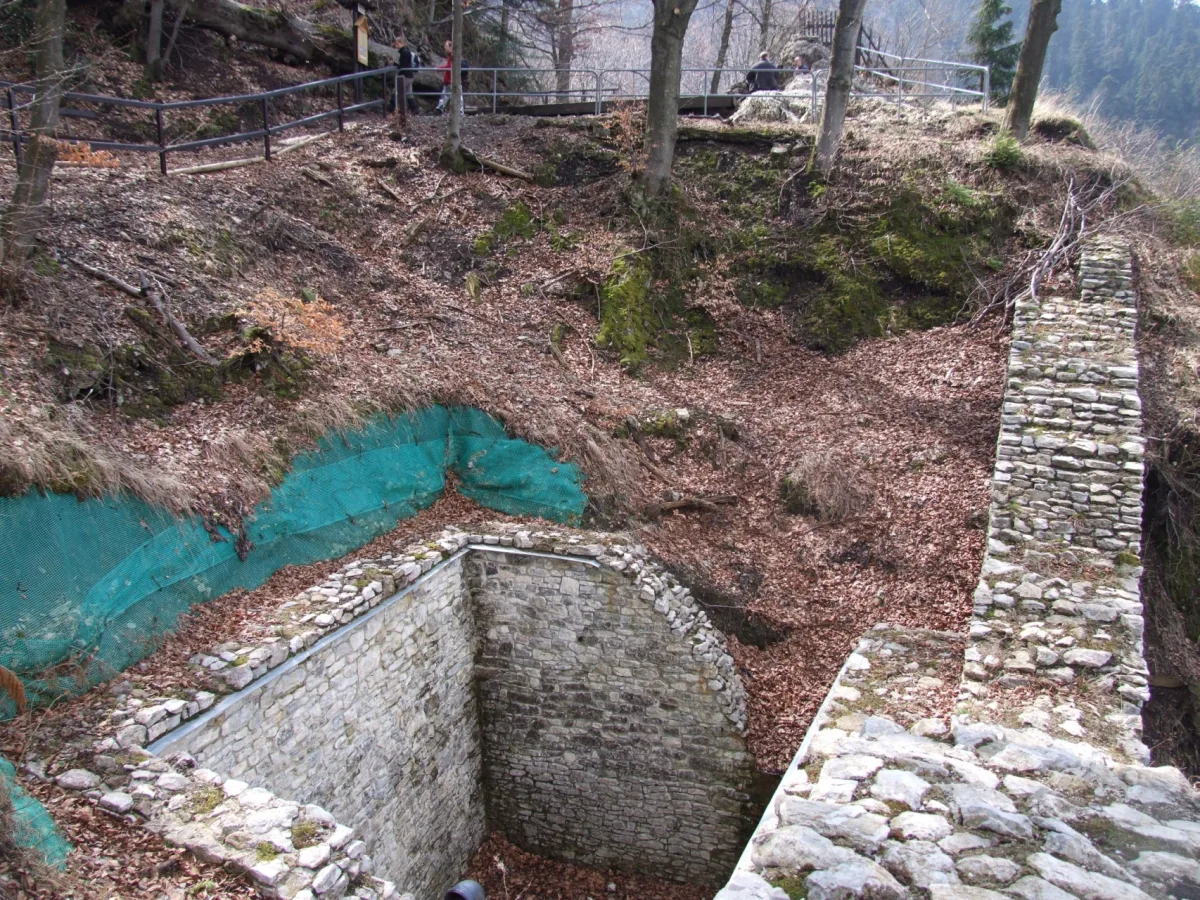
Czchów Castle stands on Baszta hill. From the 13th-14th century stronghold there remain a round tower 12.5 m in diameter, of sandstone, without its upper storey, and exposed foundations of the walls. The castle was meant to control the trade route along the Dunajec and housed a customs house. The first written mention dates from 1356. The tower also served as a prison, until 1772. The site has been in the heritage register since 1930.
Tropsztyn Castle in Wytrzyszczka lies less than 5 km further on, on a steep peninsula around which the Dunajec flows on three sides. The present building is a reconstruction. The stronghold was probably built in the first half of the 13th century on the initiative of the Ośmiorogi family, and the first mention dates from 1231. By 1608 it was already described as a ruin. Reconstruction began after 1993: in 1997-1998 the outer walls were raised and the east gate was recreated.
Rożnów Castle consists of two complexes. The upper, Gothic castle was built in 1336-1370 on the site of an older watchtower and today has only fragments of walls. Around 1560 Hetman Jan Tarnowski built lower down a Renaissance fortification closing the southern approaches along the Dunajec valley, with a bastion about 30 m long and cross-shaped loopholes.
Gródek nad Dunajcem Castle almost does not exist. It was probably built in the first half of the 14th century and was probably destroyed at the turn of the 14th and 15th centuries. After Lake Rożnów was created, the hill on which it stood ended up amid the water and is officially called Grodzisko Island. The portal's entry notes that this is a place to be seen from the shore rather than visited.
Melsztyn Castle is the ruin of a Gothic castle on Zamczysko hill, the residence of the Melsztyński family of the Leliwa coat of arms. Building was begun in 1347 by the Castellan of Kraków, Spicymir. In 1770 the castle was seized by Bar Confederates and then burnt by Russian troops. In 1789-1796 part of the walls was pulled down for material for the church in Domosławice. In 2018 Zakliczyn municipality began clearing the rubble, archaeological research and reconstruction. The rebuilt tower is 28 m high and open to visitors.
Furthest downstream lies Trzewlin Castle on Panieńska Hill in Wielka Wieś. What remains are traces of a dry moat and small fragments of walls hidden in vegetation. After the Swedish wars the castle was pulled down by townspeople from nearby Wojnicz. In 1832 Seweryn Goszczyński related a legend according to which the unfaithful wives of the knights of Bolesław the Bold took refuge on the hill. This is a tale with no confirmation in historical sources.
Be the first! Add a comment.
You need to log in to add a comment.
Log in