
Lesser Poland is associated with medieval castles and mountain trails, but for centuries it was also a region of labour: salt, lead, iron and oil were extracted here, railways were built and pilots were trained. Traces of this history survive in technical museums and open-air museums, from underground mines to hangars and a locomotive shed. Below is an overview arranged by raw material and means of transport, with the salt mines treated briefly.
Oil: Gorlice
According to Wikipedia, the Gorlice Oil Basin is one of the oldest areas of oil extraction and processing in the world. Shallow-lying oil, known as rock oil, had been gathered here for centuries by tar-burners, and it was used among other things in folk medicine and for greasing cart axles. In autumn 1853 Ignacy Łukasiewicz came to Gorlice, and in 1854, according to the same entry, the world's first street oil lamp was lit on a square in the Zawodzie district.
The “Magdalena” Oil Industry Open-Air Museum opened on 31 May 2012 on the site of a former oil mine on Lipowa street. In the Magdalena-Ropica Polska area, about 110 wells were drilled between 1931 and 2000 and about 310 thousand tonnes of oil were extracted. The collections include hand drilling equipment, steam and piston pumps, a pumping horse-gin, a bit forge and oil samples from various wells, differing in colour, clarity and density. The dominant feature is a drilling derrick reconstructed from the hand-dug “Ćwiartka” well from before 1880, from which there is a panorama of the Low Beskids.
Ores: Olkusz and Bukowno
The Olkusz land is a former basin of lead, silver and calamine ores. The Ponikowska Adit is a monument to this mining. When the shallow deposits were exhausted, miners went deeper and hit water, which flooded the workings. According to the information board by the adit, construction began in 1564 and was supervised by Ludwik Decjusz. The works were led by the adit master Jan Fejgl, and the costs were borne by the gwarectwa, partnerships of burghers and nobles from Olkusz and Kraków. The adit drained water by gravity and, according to the board, was 7,860 metres long. It collapsed in 1712 and was abandoned in 1917. In the forest between Pomorzany and Hutki you can see an open section, the so-called roznos, about 2,400 metres long. The underground parts are inaccessible.
The Ore Mining Museum in Bukowno tells of iron ore extraction in the Bolesławie area. It is housed in rooms of the “Skałka” School Complex, and it began with a collection that one employee assembled in the 1960s and 1970s in the culture centre of the “Bolesław” Mining and Smelting Works. In 1989 the exhibition was partly destroyed and the rest was secured in kindergarten cellars, and the museum was founded in 1990. It occupies 13 rooms and covers iron ore mining from the 13th century to the 1980s. A fitted-out adit has battery locomotives and wagons for carrying people and spoil. According to Wikipedia, visits require prior arrangement by telephone.
Salt: Wieliczka and Bochnia
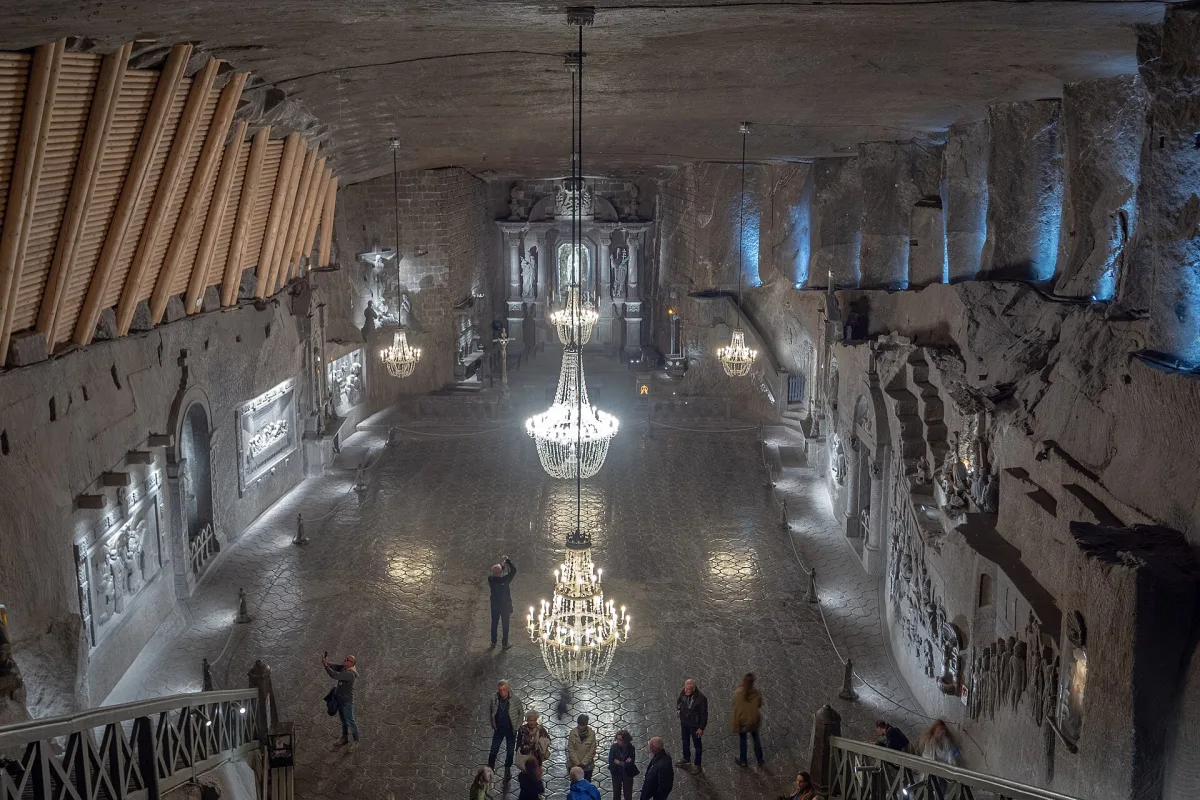
The two salt mines have separate studies, so only an outline is given here. The Wieliczka Salt Mine, together with Bochnia, formed the Kraków salt works (żupy krakowskie) from the 13th century to 1772. It was placed on the first UNESCO World Heritage List in 1978, and extraction ended on 30 June 1996. Tourists go down to it by the Daniłowicz Shaft, which was built in 1635 as one of eight new openings for transporting salt and took its name from the salt-works leaseholder Jan Mikołaj Daniłowicz. From 1887 to 1918 it bore the name of Archduke Rudolf. The shaft lost its production function in the second half of the 19th century, and today it allows a descent to a depth of 135 metres.
The Bochnia Salt Mine, according to Wikipedia the oldest salt mine in Poland, extracted salt from 1251 to 1990 and was inscribed on the UNESCO list in 2013. Rock salt was probably discovered here in 1248, during the deepening of brine wells.
Railways and roads: Chabówka and Szczucin
The Railway Rolling Stock Open-Air Museum in Chabówka operates on a siding of the station opened on 16 December 1884, which became a junction in 1899 when the line to Zakopane was opened. The locomotive shed from 1944 was destroyed by the Germans in January 1945 and rebuilt in 1947. When the Zakopane line was electrified in 1976, and the section from Sucha Beskidzka to Żywiec in 1990, steam locomotives were withdrawn from scheduled services. The collecting of exhibits began in the mid-1980s, and the open-air museum opened on 11 June 1993. Wikipedia says that it has the largest collection of historic rolling stock, and among its holdings is the TKb-1479 steam locomotive from 1877, the oldest surviving steam locomotive in Poland. Some of the vehicles are operational: from 2004, with a break in 2009-2011, retro trains ran with them.
The Road Building Museum in Szczucin is the seat of the Road Building History Unit of the General Directorate for National Roads and Motorways. It was founded in 1982 as a memorial room, and in 1992 the whole site was entered in the heritage register. The open-air collection of road machinery is laid out as a spiral path about 1.5 kilometres long, with more than 30 stations showing roads from the Cretan to the modern. On them stand steam and diesel rollers, crushers and Mazur-type tractors. It is linked to the building by a Bailey bridge 51 metres long.
Kraków: aircraft, trams, a university and electronics
The Polish Aviation Museum stands on the site of the Rakowice-Czyżyny airfield, established in 1912 for Austro-Hungarian aviation. In 1917, according to Wikipedia, it was a stopover on Europe's first regular airmail line, from Vienna to Kyiv and Odesa. The airfield was closed in 1963, and its complex of buildings was entered in the heritage register in 2006. The nucleus of the collections was aircraft from the former German collection Deutsche Luftfahrtsammlung. Wikipedia gives the number of aircraft on display as over 200, and the museum's website speaks of more than 250 aeroplanes, gliders and helicopters, so the figures depend on how they are counted. The new building, whose plan resembles a propeller, opened on 18 September 2010.
The Museum of Engineering and Technology is housed in a historic tram depot on św. Wawrzyńca street in Kazimierz. It was established on 1 October 1998 as the Museum of Municipal Engineering, and it has had its present name since 11 March 2022. It collects exhibits on urban transport, power stations and the gas industry. Renovation of the halls proceeded in stages from 2000, and its branches are the Stanisław Lem Experience Garden and the Czyżyny Hangar.
The Museum of the History of AGH and the History of Technology has operated since 1960 within a centre established three years earlier. It has four sections: crafts and industry, a modelarium of mining and metallurgical equipment, the history of the university and its contacts with John Paul II. It is visited by telephone reservation. Quite different in character is the Museum of Electronics on Wrocławska street, created by two brothers: its founders write that there are no glass cases or barriers here and that most of the collection may be touched. It has Polish electronics, computers, consoles and about 40 video-game stations.
The dairy in Królówka
The Dairy Museum in Królówka, a branch of the Museum of the Wiśnicz Land, is set up in the building of a dairy founded in 1888 by the local parish priest. From 1896 it operated as a dairy company, then a cooperative, until the 1970s, and in 1991 the building was taken over by the Nowy Wiśnicz municipality. According to surviving documents, butter, cheese, cream and buttermilk went to the court of Emperor Franz Joseph I. Here you can see complete milk-processing machines, some from the 19th century.
Be the first! Add a comment.
You need to log in to add a comment.
Log in