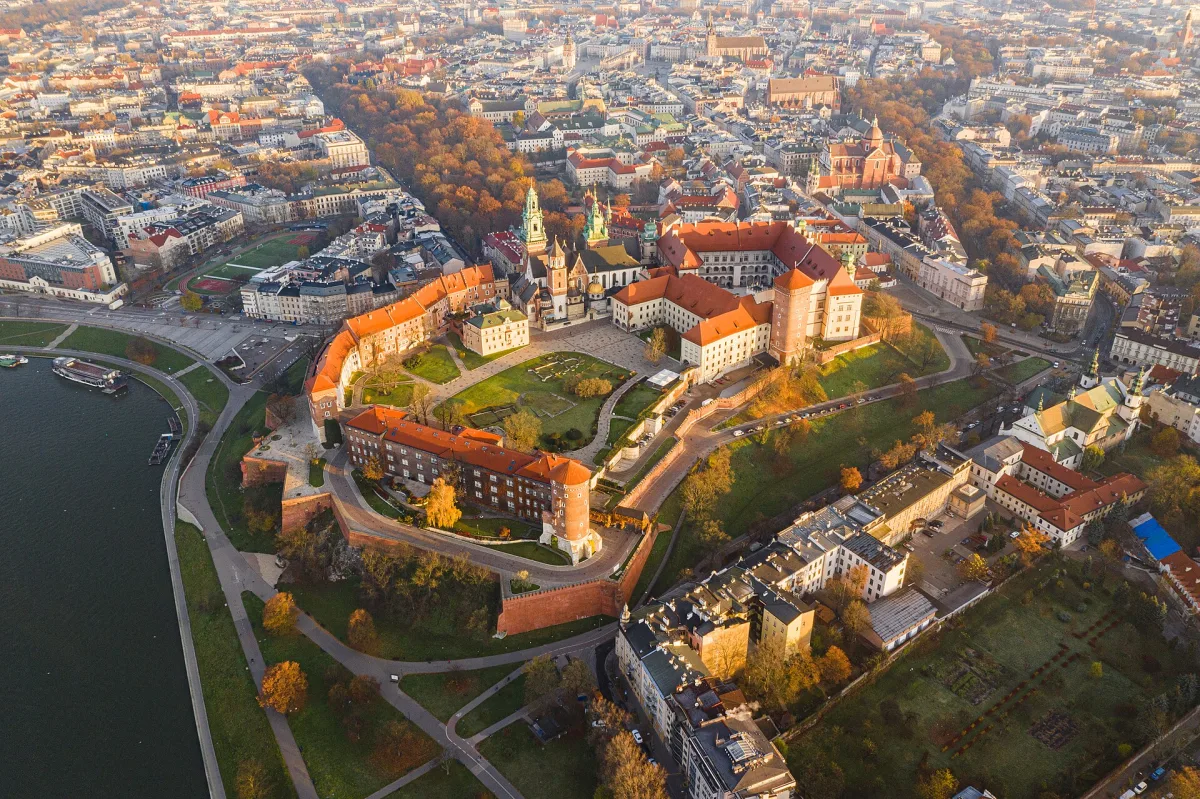
A limestone hill on the Vistula in Kraków with the royal castle, cathedral, towers, gardens and the Dragon's Den, part of a UNESCO World Heritage Site.
Wawel Hill is a limestone hill on the left bank of the Vistula, in the centre of Kraków, about 228 m above sea level. For centuries it was the seat of rulers and bishops, and today it is one of the most important places in Polish history. This page describes the whole hill and how to plan a visit, while each of the main buildings has its own entry.
Wawel is a tectonic horst built of Upper Jurassic limestone that formed some 155-161 million years ago. Limestone is a karst rock, which is why the hill contains caves, and one of them, the Dragon's Den, can be visited. The name of the hill probably derives from Old Polish words meaning a prominence among marshes.
Until 1954 Wawel was a separate district of the city (District II Zamek), and today it belongs to the Old Town. Traces of settlement on the hill go back about 100,000 years, and the Kraków bishopric was established here in 1000. After 1038-1039 Kraków became the capital of the state and Wawel its centre of power.
The two main complexes are Wawel Royal Castle, with its arcaded courtyard, state rooms and treasury, and the cathedral, described in the entry on the Archcathedral Basilica of St Stanislaus and St Wenceslaus. The cathedral is the burial place of kings and great national figures, and the Sigismund Bell, cast in 1520, hangs beside it.
Besides these, the hill has several less obvious places. They include Romanesque remains of churches and a rotunda (among them the Rotunda of the Blessed Virgin Mary from the turn of the 10th and 11th centuries), defensive towers (the Senatorska, Sandomierska, Złodziejska, Tęczyńska and others), gates and the reconstructed royal gardens. The Dragon's Den also belongs to the hill, and the sculpture linked to the legend of the dragon is described in the entry Wawel Dragon (sculpture).
The first cathedral was built in the 1020s, the second, Romanesque one was consecrated in 1142, and the third, Gothic one was begun in 1320 by Władysław the Elbow-high (consecrated in 1364). The Renaissance rebuilding of the royal residence under Sigismund the Old took place in 1507-1536, and the Sigismund Chapel was built in 1517-1533.
In 1609 Sigismund III moved permanently to Warsaw, and a fire in 1702, during the Great Northern War, almost completely destroyed the castle. After the Third Partition (1795) Wawel came under Austrian rule, and the Austrians set up barracks on the hill and demolished part of the buildings, including the churches of St George and St Michael. The army left the hill after the emperor's consent in 1905, and a long reconstruction began.
In 1921 the Sejm recognised the castle as a residence of the President of Poland. During the Second World War the Governor-General Hans Frank resided at Wawel, and the Germans left the hill on 18 January 1945. Since 1978 Wawel, together with the Old Town, Kazimierz and Stradom, has been on the UNESCO World Heritage List, and in 1994 it was declared a Monument of History.
The hill consists of several parts that are visited separately: the exhibitions in the castle (royal chambers, treasury, armoury and others), the cathedral with the royal tombs and the bell, the Cathedral Museum, the archaeological exhibition Lost Wawel, the Dragon's Den and the gardens. There are more exhibitions than can be seen in a single day, so it is worth choosing two or three and leaving the rest for next time.
The castle sells tickets online, offers audio guides and guides, and has days with free admission as well as the Accessible Wawel programme. Opening hours and entry rules for individual exhibitions change with the season, so check them on the castle's website before your visit.
The hill is surrounded by other places. The Manggha Museum is about 0.5 km away, the Church of Saints Peter and Paul about 0.4 km, and the Main Market Square is about 0.8 km away.

Be the first! Add a comment.
You need to log in to add a comment.
Log in