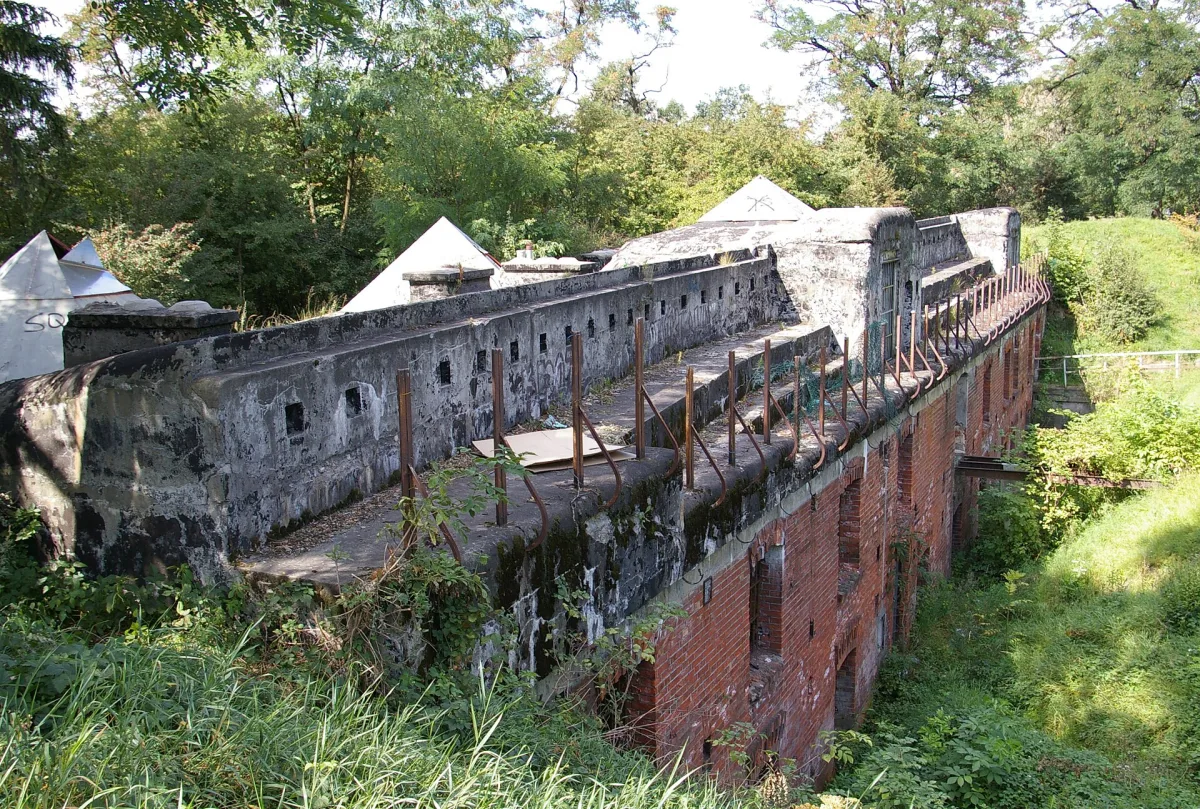
An Austrian system of forts, ramparts and batteries from 1849-1916 around Kraków, with 34 surviving forts.
Kraków Fortress is a complex of Austrian fortifications built and modernised, with interruptions, in 1849-1916 around the city and the surrounding villages. The city was declared a fortress in 1856, and kept that status until 1917. It was one of the larger fortresses in Europe.
The decision to build was announced by Emperor Franz Joseph I on 12 April 1850. In the end three defensive rings were created: a core around the old city, a second ring of redoubts and forts, and a third, outer one, of artillery and armoured forts. They were supplemented by batteries, fortress roads, barracks, hospitals and storehouses. Wawel served as the citadel. The core was demolished by 1909, leaving only three bastions.
The fortress gained real fighting strength in the summer of 1914, although it was not besieged by Russian troops. In the Second Polish Republic it no longer had military significance. After the Second World War many structures were demolished, especially in the 1950s, among them Fort "Kościuszko", "Lubicz", "Krakus" and "Krowodrza". Opposition from the scholarly community halted the mass demolitions, and since the 1980s adaptation and conservation work has been under way.
34 forts have survived, and together with smaller defensive works about 120-140 structures in Kraków and in the villages of Węgrzce, Zielonki and Bibice. They include the artillery tower Fort 31 "Benedykt" and the armoured Fort 48a "Mistrzejowice". They are surrounded by more than a thousand hectares of greenery, including more than 380 hectares of old-growth trees.

Be the first! Add a comment.
You need to log in to add a comment.
Log in