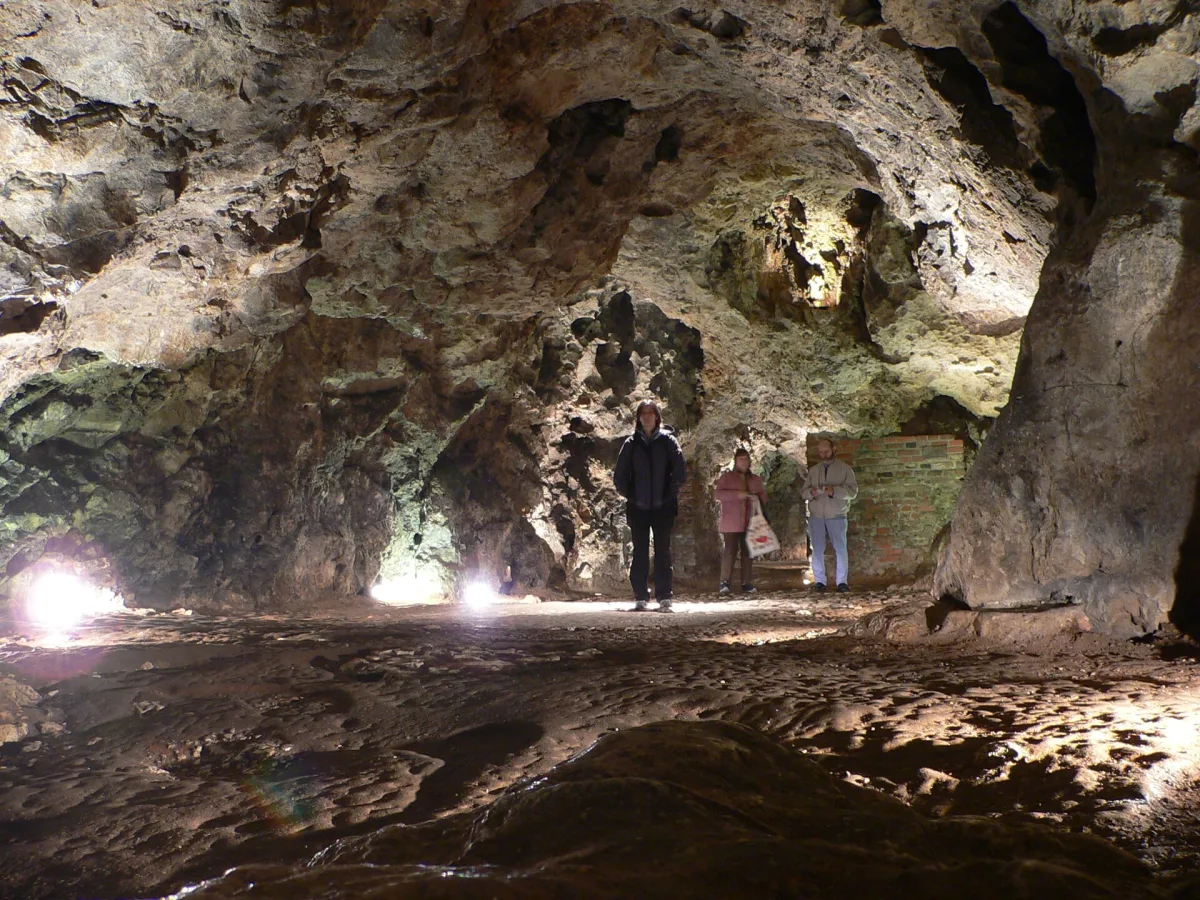
A karst cave at the foot of Wawel Hill with a tourist route and a sculpture of the Wawel Dragon, linked to the legend of the dragon.
Smocza Jama (the Dragon's Den) is a karst cave at the foot of Wawel Hill, with which, according to legend, the Wawel Dragon is associated. It is one of the most famous tourist caves of Kraków. It is entered from the grounds of Wawel Hill, and the exit is outside the walls, towards the Vistula. Before the exit stands a sculpture of a dragon, made by Bronisław Chromy and put up in 1972.
According to the legend the Wawel Dragon lived in the den. This tale is a folk story, not a historical fact, and it became attached to this cave. The sources do not indicate that anything confirming it was found in the cave, so treat it as part of the city's folklore.
The cave is mentioned in written sources as early as the first half of the 16th century. In 1565 King Sigismund Augustus ordered its entrances closed for safety reasons. Earlier it reportedly housed a well-known inn and gave shelter to the poor and to vagrants. At the end of the 18th century the lower entrance was walled up during fortification work.
In 1829 Ambroży Grabowski got inside through an opening in the ceiling. In 1842 the Senate of the Free City of Kraków cleaned the cave and opened it to the public. In 1918 Professor Szyszko-Bohusz built a spiral staircase of 136 steps and electric lighting was installed, and the opening took place on 3 August of that year. The first scientific research was carried out in the second half of the 19th century by Alojzy Alth in 1874, and systematic work began in 1966. In 1974 miners under the supervision of AGH adapted the cave for tourists and drove a four-metre tunnel into previously unknown parts.
The whole cave is about 276 m long, of which the tourist route is about 82 m, and the difference in level is about 15 m. The entrance lies at an altitude of about 205.5 m above sea level. The visit begins with the spiral staircase and then leads through three chambers. The largest is about 25 m long and 10 m high. The exit is outside the castle walls, close to the Vistula.
Before the exit stands the sculpture of the Wawel Dragon. The cave is entered in the heritage register, and the register gives the date 1790-1794. A visit is easily combined with Wawel Hill, where the Royal Castle and the cathedral stand.

Be the first! Add a comment.
You need to log in to add a comment.
Log in