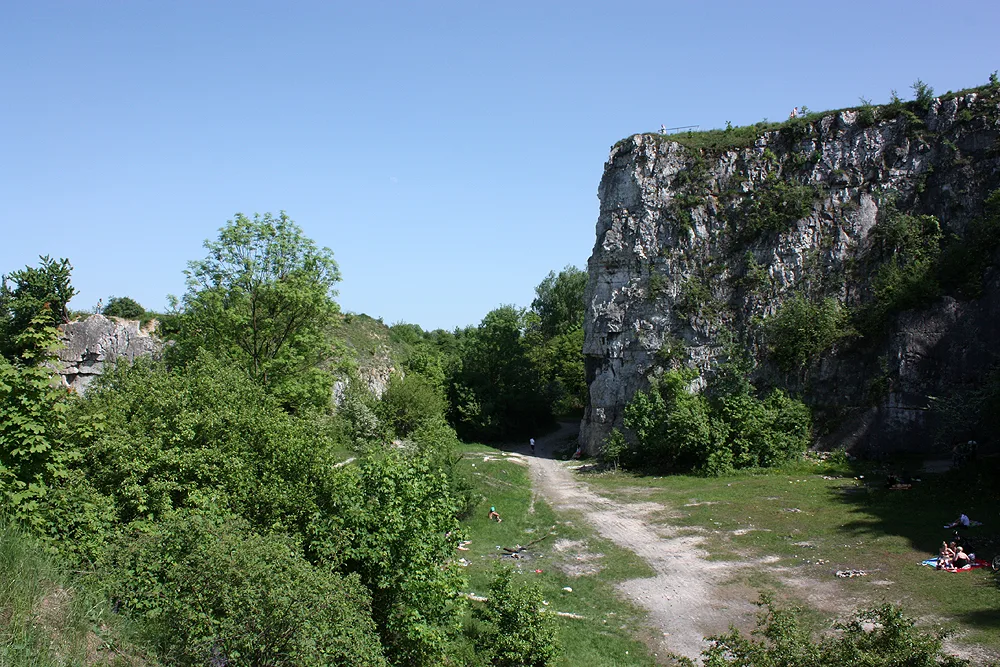
A city park of 34 ha in Dębniki, with limestone rocks, disused quarries and a climbing area.
Skałki Twardowskiego (Twardowski's Rocks) is a city park in Dębniki, about 3 kilometres from the centre of Kraków, between ulica Tyniecka, ulica Norymberska and ulica Zielna. It occupies the horst hill of Krzemionki Zakrzowskie, also called Zakrzówek, and forms part of the Kraków City Forests and the Bielany-Tyniec Landscape Park. The area covers 34 hectares, is used for recreation and is a refuge for nature in the city.
The name comes from the legend of Master Twardowski. According to it, the sorcerer had his workshop here, and when the laboratory exploded, the rocks formed on this spot. The legend is a folk tale, not a geological fact.
This hill is one of the seven horsts of Kraków, formed in the Tertiary as a result of tectonic movements. It lies at an altitude of 200-230 m above sea level. It is built of Late Jurassic Oxfordian limestones, bedded, less often rocky and chalky, with siliceous nodules and karst forms: sinkholes, caves and rock shelters. The limestone was formerly quarried here for building, later for road construction, for lime kilns and for plants producing soda. The disused quarries in the area are Łom Bergera, Skałki Twardowskiego, Kapelanka and Zakrzówek.
The area has historical significance, as climbing took place here over 100 years ago. Sectors stand out with names such as Baba Jaga, Ciąża, Freney, Niski Mur, Problemówka, Rdzawe Zacięcie, Szara Ścianka and Sadystówka. The rock walls reach up to 32 metres in height. Dry tooling is also practised on the rocks, including in winter. Climbing requires equipment and skills, and a walker can limit themselves to the paths.
In 2011, 579 species of vascular plants were recorded here, including 448 native ones. Four of them are on the Red List of Plants of Poland: the lanceolate moonwort, the early sedge, the Siberian iris and the meadow pasqueflower. The area has one of the best patches of xerothermic grassland in Kraków.
From Dębniki it is not far to Henryk Jordan Park and on to the Kościuszko Mound. By the Vistula stands the Manggha Museum, and beyond it begins the Wawel area and the sculpture of the Wawel Dragon.

Be the first! Add a comment.
You need to log in to add a comment.
Log in