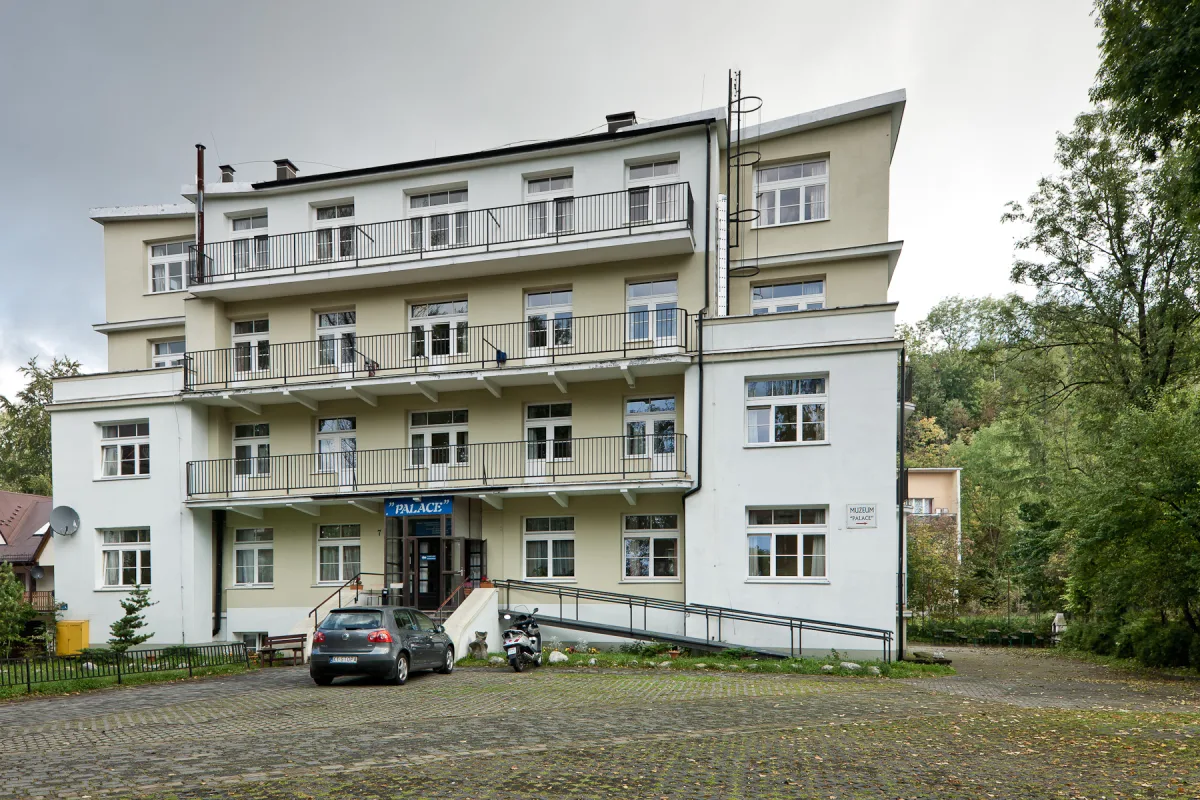
A branch of the Tatra Museum in the former Gestapo headquarters in the Podtatrze region, at Chałubińskiego 7 in Zakopane, with cells in the cellars.
Museum Palace in Zakopane is a branch of the Tatra Museum, being set up in the former Gestapo headquarters in the Podtatrze region, at Chałubińskiego 7. The building, known during the occupation as the “Torture House of Podhale”, is a place of remembrance of the prisoners and of the people who were active in the resistance movement in Podhale.
The Palace guesthouse was built to a substitute design of 1930 by Franciszek and Leon Kopkowicz, and the occupancy permit was issued on 23 February 1931. It was a modernist building with reinforced concrete columns and a reinforced concrete flat roof, unusual for Podhale. On the same plot there had earlier stood the wooden villa “Pepita”, designed by Stanisław Witkiewicz, which burned down in 1928.
In 1940 the occupier set up a Gestapo post in the building, whose supervision covered what was then Nowy Targ County. The cellars were adapted into a prison, and on the upper floors interrogation rooms and the Gestapo officers' apartments were arranged. Arrested members of the resistance and people who helped with smuggling people to Hungary were brought to the “Palace”. According to the museum, on 30 May 1944, 20 prisoners from the “Palace” were shot in the Kuźnice Glade, where today stands the monument “Prometheus Shot” by Władysław Hasior. On the night of 26 to 27 January 1945 the Gestapo officers left the building and burned the documentation before leaving.
A memorial room in the former cells was opened in 1993, and it is still run by the Association of the Museum of Struggle and Martyrdom “Palace” - Torture House of Podhale, on an area of 60 m2. In 2020 the building was taken over by the Tatra Museum, which designated it entirely for museum purposes.

Be the first! Add a comment.
You need to log in to add a comment.
Log in