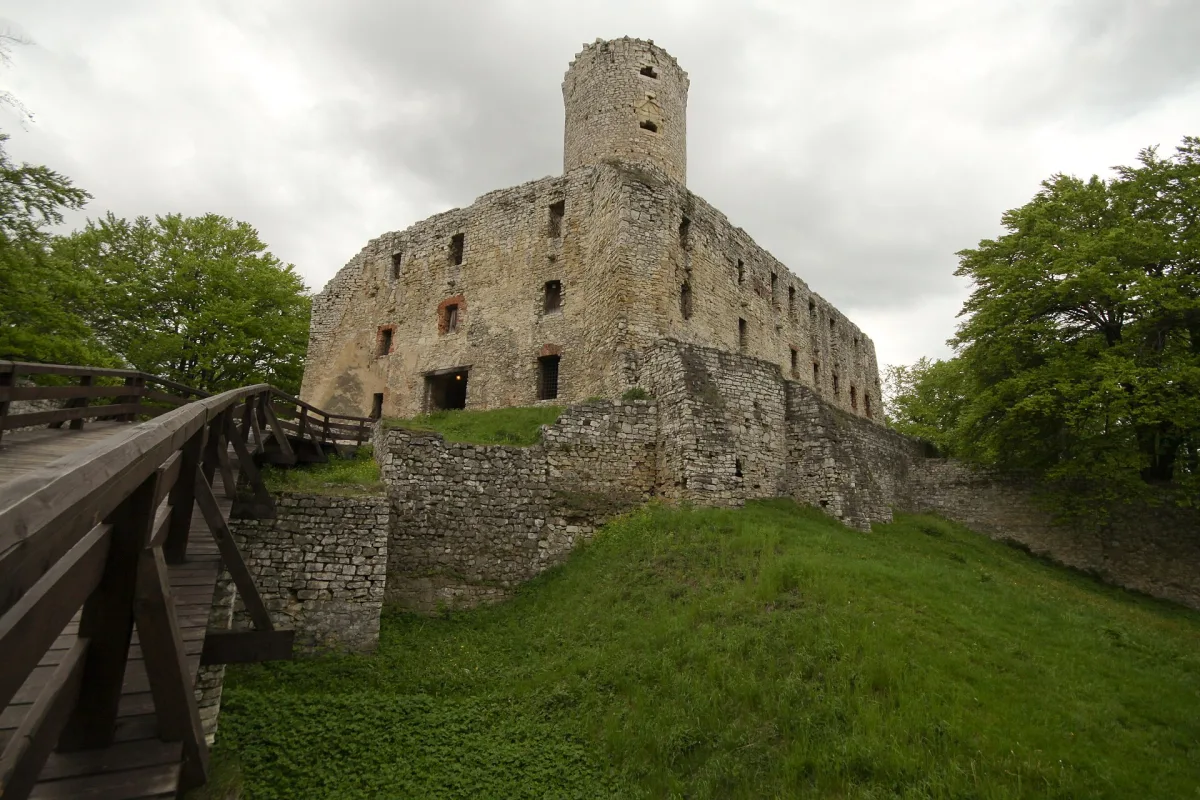
A Gothic stronghold of the bishops of Kraków on a limestone hill in Wygiełzów, a former prison for clergy, today a ruin with a viewing tower and a museum.
Lipowiec Castle is a Gothic stronghold of the bishops of Kraków on a limestone hill 362 m above sea level, in the village of Wygiełzów, in Babice municipality. Today it is a permanently secured ruin with a tower on which a viewing terrace has been set up. It lies in the Kraków-Częstochowa Upland (Polish Jura), on the Tenczyn Ridge, and according to Wikipedia it forms part of the Trail of the Eagles' Nests. The castle itself stands within the “Lipowiec” nature reserve and is entered in the heritage register.
Before 1243 the hill belonged to the Gryfita family and for a short time to the Benedictine nuns' convent in Staniątki. Around 1243 it was acquired by Jan Prandota, Bishop of Kraków. In the second half of the 13th century a wooden stronghold stood here, and in the 13th-14th centuries a masonry castle began to be built. The heritage register dates the building to the early 14th century.
The castle was extended by Bishop Jan Muskata, who used it as a point of resistance against Władysław the Elbow-high. In the 15th century, under Bishops Wojciech Jastrzębiec and Zbigniew Oleśnicki, the main body was enlarged and modernised for defence, with the addition of gun platforms and terraces with loopholes. Zabytek.pl draws attention to the artillery openings on the two upper storeys of the tower, which are rare in Poland.
From the 15th century the castle also served as an ecclesiastical prison, and in the 16th century this role grew. Among those held here was Franciszek Stankar. According to a story repeated in the sources, he escaped in 1550 by lowering himself on ropes supplied by the warden's daughter. In the 18th century the castle served as a house of correction for clergy.
A great fire in 1629 destroyed the wooden buildings. In 1655 the castle was occupied by the Swedes, who left it in the summer of 1657, setting it on fire. Rebuilding was undertaken in the 1730s. After 1789 the castle passed to the state treasury, then into private hands, and around 1800 another fire destroyed the roofs and interiors. After the 1840s it was abandoned and fell into decay, and conservation work in 1961-1975 secured it as a permanent ruin. Since 2007 it has belonged to the museum, now the Museum of Western Lesser Poland in Wygiełzów.
The upper castle is pentagonal in plan, with an inner courtyard, and the ground floor housed service rooms. A well cut into solid rock, more than 24 m deep, draws attention, with a wooden winch above it. On the first floor there were a chapel, prison cells and a museum section.
The round tower, from the turn of the 13th and 14th centuries, is about 30 m high and was originally a free-standing keep with an entrance at a great height. From the viewing terrace a panorama opens to the south, and in good weather the Beskids can be seen. The museum's website also mentions that in April 1943 the castle briefly served as a refuge for Captain Witold Pilecki after his escape from Auschwitz.
Right next to the castle, about 300 m away, is the Vistula Ethnographic Park, a joint part of the museum's offer.
It is worth a look at the All Saints parish church complex in Babice, about 800 m from the castle.

Be the first! Add a comment.
You need to log in to add a comment.
Log in