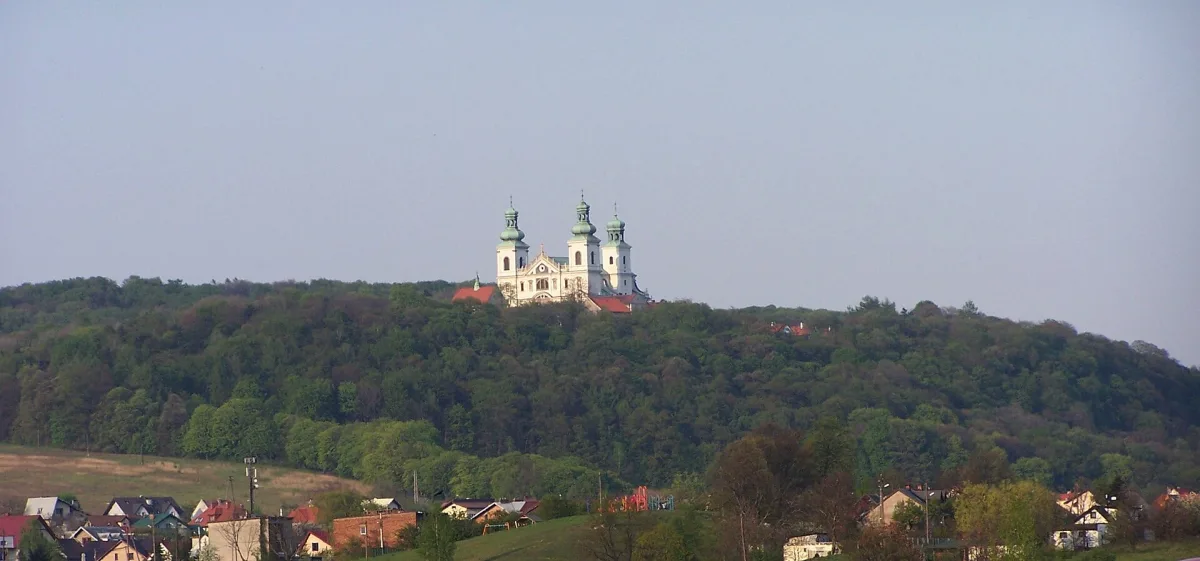
A woodland area of 419 ha in western Kraków, with a zoo, three nature reserves, the Piłsudski Mound and a Camaldolese church.
Wolski Forest (Las Wolski), also called Lasek Wolski, is a woodland area in the western part of Kraków, mostly within Wola Justowska, in the Zwierzyniec district. It covers 419 ha, is a fragment of the Kraków City Forests and serves recreational functions. Within its boundaries is the Kraków Zoo.
The forest covers the highest hills of the Sowiniec Range, with its culmination at Sowiniec (358 m above sea level). The relief is varied with gorges and ravines. Thirty-two tree species grow here, and about 89 per cent of the area is occupied by stands dominated by oak, beech and birch. Three nature reserves lie in the forest: Bielańskie Skałki (floristic, 1950), Panieńskie Skały (forest and landscape, 1953) and Skałki Przegorzalskie (floristic, 1959).
In 1917 the forest land was bought by the Savings Bank of the City of Kraków and handed over to the city to serve as a people's park. The zoo has operated here since 1929. The Piłsudski Mound, about 35 m high, was built in 1934-1937. The modernist Okocim Pavilion of 1936 now houses the "Symbioza" Centre for Ecological Education.
On Srebrna Góra stands an early Baroque Camaldolese church from the early 17th century. In Przegorzały there are Villa Baszta, designed in 1928 by Adolf Szyszko-Bohusz, and Przegorzały Castle.
There are several recreation clearings in the forest: the largest is the Juliusz Leo Clearing (2.42 ha), and there are also the Sowiniec Clearing, the Bielany Clearing and the Scouts' Clearing. The network of walking paths is about 40 km long, and part of it is marked. Several hiking trails run through the forest (red, green, yellow, blue, black), as well as a section of the Kraków Fortress route. The infrastructure is completed by car parks and catering points.

Be the first! Add a comment.
You need to log in to add a comment.
Log in