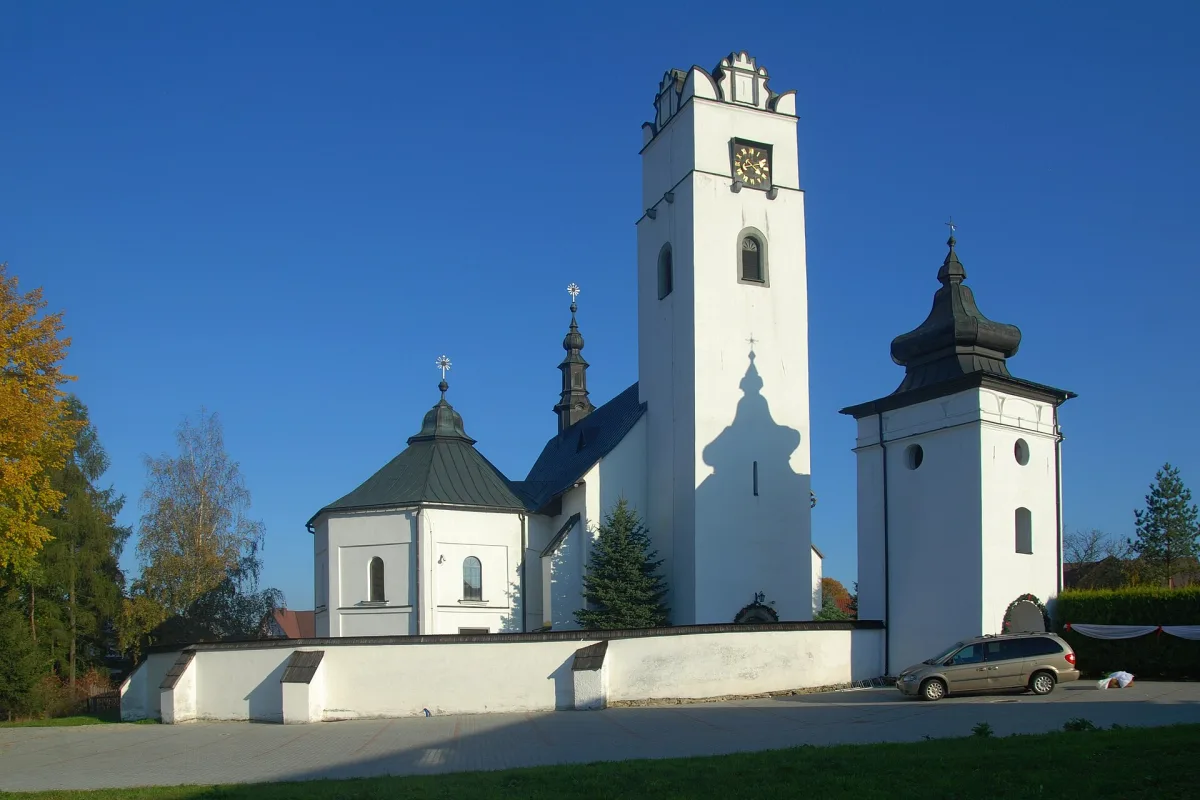
A Gothic church from the turn of the 13th and 14th centuries, regarded as the oldest sacred monument in the Podtatrze region, with a Baroque interior and tower parapet.
The Church of St Stanislaus in Frydman was built at the turn of the 13th and 14th centuries and is regarded as the oldest monument of sacred architecture in the Podtatrze region. The oldest parts are Gothic, and later rebuilding gave it features of Baroque in the Spiš-Slovak-Czech variety. It lies on the Gothic Trail.
The Early Gothic core was built of quarried stone extracted on the nearby Szubieniczna Góra. The single-nave church is buttressed on the outside with stepped buttresses, the chancel is closed on several sides, and the three-bay nave has a barrel vault from 1708. Among the oldest elements are a Romanesque-shaped small window in the east wall of the sacristy, an Early Gothic stone head on a corner of the nave and the portal on the south side. Gothic tracery has survived in the windows.
On the north side an octagonal Chapel of Our Lady adjoins the nave, added in 1764. The tower is crowned from the west by a parapet from the end of the 18th century, and at the height of the clock one can see wooden corbels, a trace of a former watchman's porch called a hoarding.
In 1587 the church was taken over by the Lutherans, and it returned to the Catholics in 1640. Thorough renovations were carried out in 1640 to 1642 and in 1683, and after the fire of 1708 it was rebuilt in 1750 (the roofs) and in 1751 to 1757 (the interior). Another fire in 1783 consumed the roofs and the tower. In 1971 to 1978 the walls and the tower parapet were renovated and strengthened.
The furnishings are mostly Late Baroque and date from 1751 to 1769. In the high altar, behind the curtain of the painting, there is a niche lined with mirrors with a scene of the murder of St Stanislaus. The Rococo altar in the Chapel of Our Lady is double-sided and accessible from all sides. In 1760 the church was surrounded by a wall with two gates and a walk-through bell tower, in which hangs the largest bell, called Bratni (the Brotherly). A tradition says that John III Sobieski served at Mass here on his way back from Vienna through Zamagurie.
It is about 2.5 km from here to the wooden church in Dębno, and on the reservoir lies Lake Czorsztyn with the castles in Czorsztyn and in Niedzica.

Be the first! Add a comment.
You need to log in to add a comment.
Log in