German ghetto in Olkusz, which existed from September 1941 to June 1942 and held about 3,400 people.
The Olkusz Ghetto existed from September 1941 to June 1942. The Germans confined in it the Jewish population of the town and its surroundings. It covered the north-eastern part of Olkusz and the villages of Sikorka and, in part, Parcze and Słowiki, today districts of the town. The boundary reached the crossing of Francesco Nullo and Kościuszki streets.
According to data from 1937, Olkusz had 2,700 Jewish residents. From the beginning of the occupation they were subjected to repression, and from October 1940 they were deported to labour camps in the Reich. A Judenrat was appointed in October 1939.
The resettlement took ten days, and Poles were evicted from the houses within the ghetto. The ghetto was not fenced, but German and Jewish policemen guarded the entrances. Conditions were harsh: the daily bread ration was 250-300 g, and 7-8 people lived in each room. A community kitchen operated in the former grammar school on Augustiańska Street, a hospital in another building, and also a kindergarten for about 30 children. Residents did forced labour, among other places in a suitcase factory. In March 1942 the Germans publicly hanged three Jews on the square left by the Augustinian monastery.
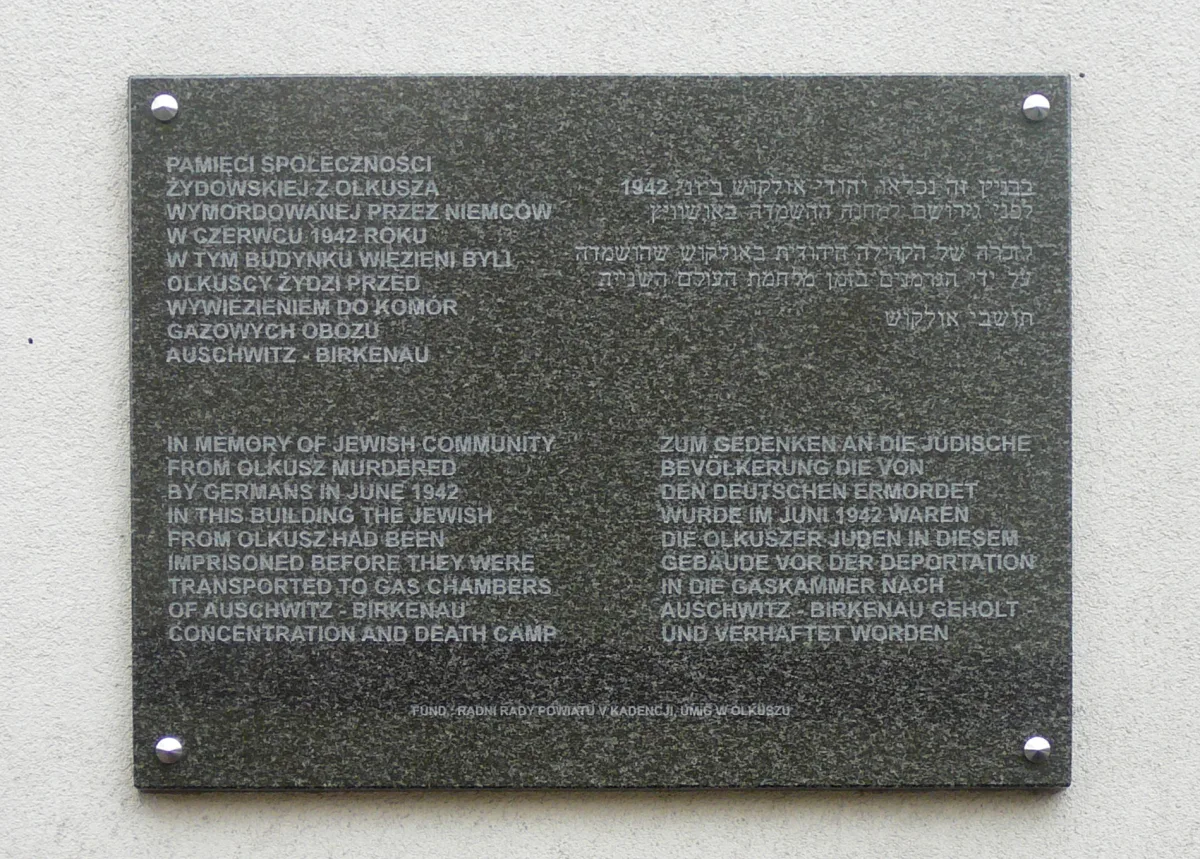
The liquidation began in the night of 9 to 10 June 1942. Within less than a day about 3,400 people were assembled, and the Germans carried out a selection: about 200 were judged fit for work. The rest were deported in transports on 13 and 15 June, about 3,000 people in total. According to Wikipedia most were murdered in gas chambers, most likely at Auschwitz II-Birkenau, and researchers do not agree on the place of extermination.
A trace of the Jewish community is the old Jewish cemetery in Olkusz. The history of the town is told by the PTTK Regional Museum.

Be the first! Add a comment.
You need to log in to add a comment.
Log in