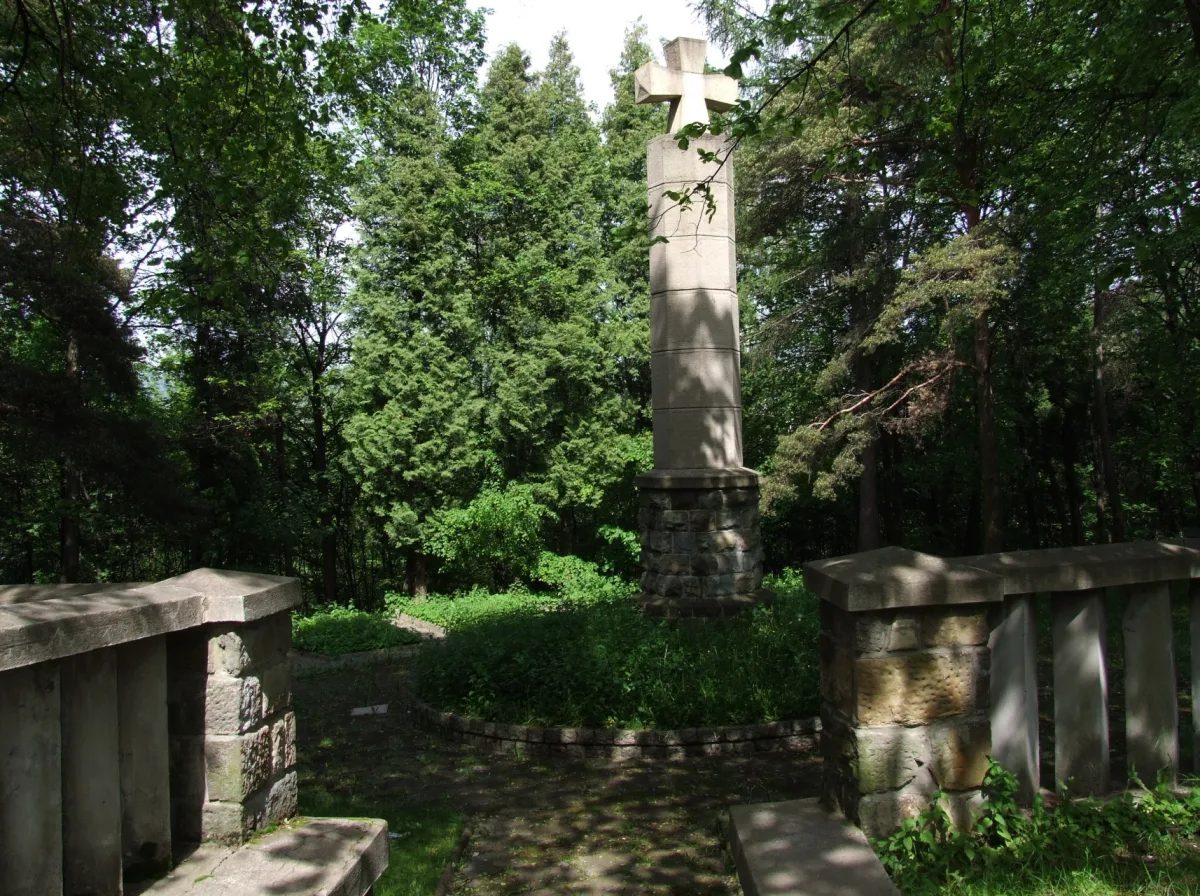
A First World War cemetery with graves of Austro-Hungarian and Russian soldiers who fell in December 1914, and a plot of Soviet soldiers.
War Cemetery No. 368 in Limanowa-Jabłoniec is a cemetery from the First World War period on Jabłoniec hill, entered in the heritage register in 1991. It holds soldiers of the Austro-Hungarian and Russian armies who fell in December 1914 during the Limanowa-Łapanów operation, and also Soviet soldiers buried after the Second World War.
The Limanowa-Łapanów operation lasted from 7 to 12 December 1914 and ended in a victory for the Austrian forces, who halted the Russian offensive towards Kraków and Silesia. The fortified hill of Jabłoniec was taken on 11 December, mainly in hand-to-hand fighting, by Hungarian hussars. The commanding officer, Colonel Othmar Muhr, was killed in this fighting. The burials took place from 13 to 20 December 1914, on the orders of the Austrian command, with the help of peasants from the surrounding villages. The soldiers were laid to rest without coffins, wrapped in military coats, separately for each army.
According to the Wikipedia entry and the website miejscapamiecinarodowej.pl, 161 soldiers of the Austro-Hungarian army, 1 German and 247 soldiers of the Russian army are buried here, 409 people in all from the First World War. Inside the wall there are 31 single graves and 34 mass graves. The headstones of Austrian soldiers are topped with cast-iron Latin crosses, those of Russian soldiers with cast-iron Orthodox crosses. In the lower part stands an obelisk in memory of the fallen Hungarian Honvéd soldiers, and at the place where Colonel Muhr died, his monument.
On a terrace on the north side of the walking path, a cemetery of Soviet soldiers and partisans, moved from across Limanowa County, was laid out after the Second World War. Wikipedia gives 250 buried, and the website miejscapamiecinarodowej.pl 236, so the number is not firmly established.
The cemetery belongs to District X and is a representative cemetery. It was designed by Gustav Ludvig (1876 to 1952), and work began in 1915, still during the war. It was carried out mainly by Italian prisoners of war under the direction of the Kraków artists Henryk Uziembło and Jan Szczepkowski and the Slovak Dušan Jurkovič. The hill was shaped into an earthen embankment with a stone plinth and a walking terrace 128 m long, beside which a stone obelisk with a Maltese cross was erected. The cemetery, enclosed by a stone wall, is entered through two wrought-iron gates, between which stands an octagonal chapel-mausoleum with a dome. Othmar Muhr once rested in it, but his remains were moved in the interwar period to the family tomb in Hungary.
The cemetery was renovated in 2014, on the hundredth anniversary of the battle, as the website miejscapamiecinarodowej.pl states. The graves lie on a steep southern slope among greenery, and the place has the character of a landscape park. On nearby Golców there is a second, smaller cemetery linked with this battle: No. 369 (Stara Wieś-Golców).

Be the first! Add a comment.
You need to log in to add a comment.
Log in