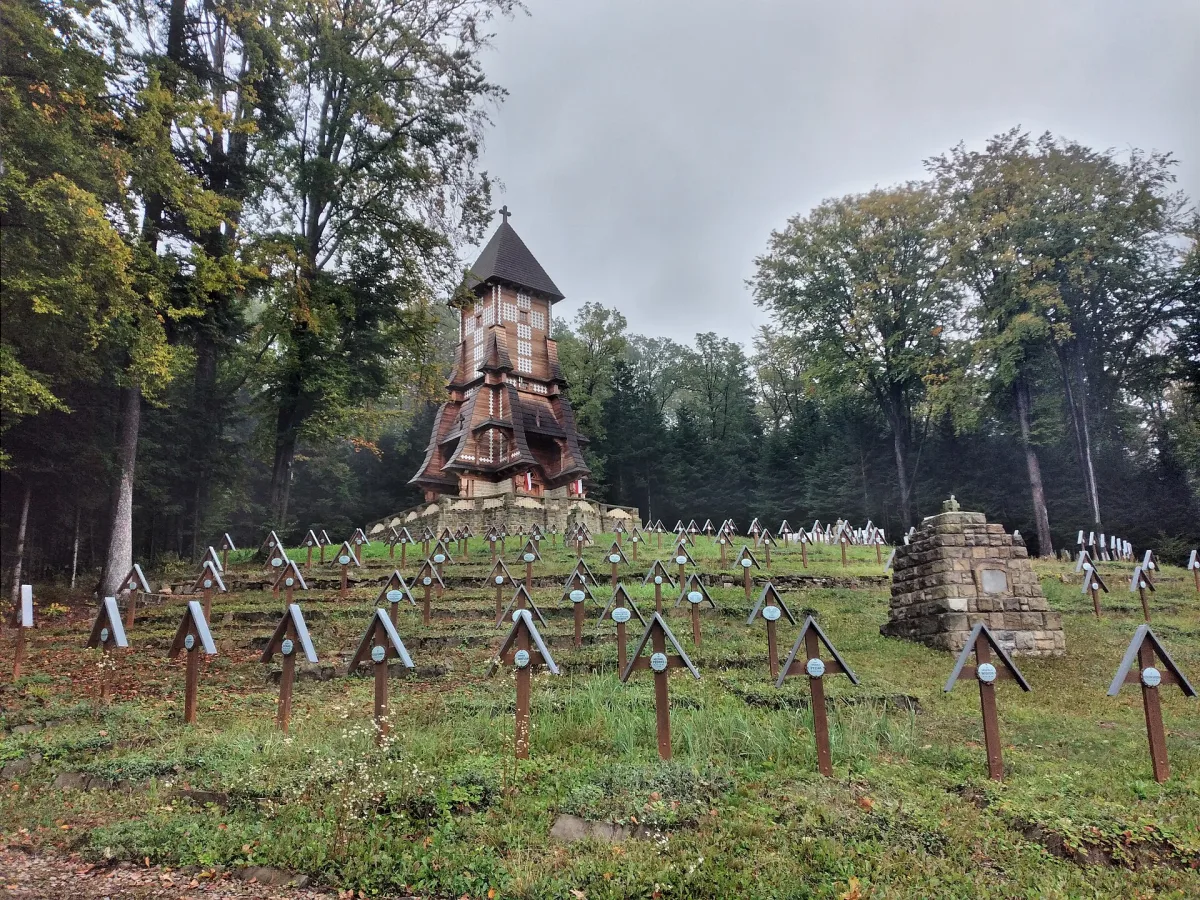
A war cemetery from 1915 on Pustki hill, where 1204 soldiers of the Austro-Hungarian, German and Russian armies lie; it has held the European Heritage Label since 2016.
War Cemetery No. 123 lies on Pustki hill in Łużna, in Gorlice County. It was created after the fighting of May 1915, when during the Battle of Gorlice Austro-Hungarian and German forces took the hill held by Russian troops. Soldiers of three armies lie here.
According to Wikipedia, the cemetery contains the graves of 912 soldiers of the Austro-Hungarian army, 65 of the German army and 227 of the Russian army, 1204 people in total. Wikipedia notes that about half of the Austro-Hungarian soldiers were Poles. The graves consist of 46 mass graves and 829 individual ones, and the cemetery covers 29,152 m². A further 154 Russian soldiers killed at Pustki were buried in the nearby Cemetery No. 122.
The sources give two names. Wikipedia says that the cemetery was designed by Jan Szczepkowski, artistic head of Section IV Łużna, and that after his dismissal the work was completed by the Slovak architect Dušan Jurkovič. The wooden chapel, known as a gontyna, built in a style combining Carpathian and Old Slavic architecture, is attributed to Jurkovič. The heritage register does not name a designer.
According to Wikipedia, the wooden gontyna at the top is 24.30 m high without the cross. It burned down on 29 June 1985 and was rebuilt in 2014 on the basis of surviving documentation. Renovation of the cemetery began in July 2014, and the main work was completed by 2018.
The cemetery is entered in the heritage register under number A-563 of 29 June 1988. According to Wikipedia, in 2016 it received the European Heritage Label: the European Commission added it to the list in February, and the formal award took place in April in Brussels. Łużna municipality states that independent experts nominated it for the label on 2 December 2015.

Be the first! Add a comment.
You need to log in to add a comment.
Log in