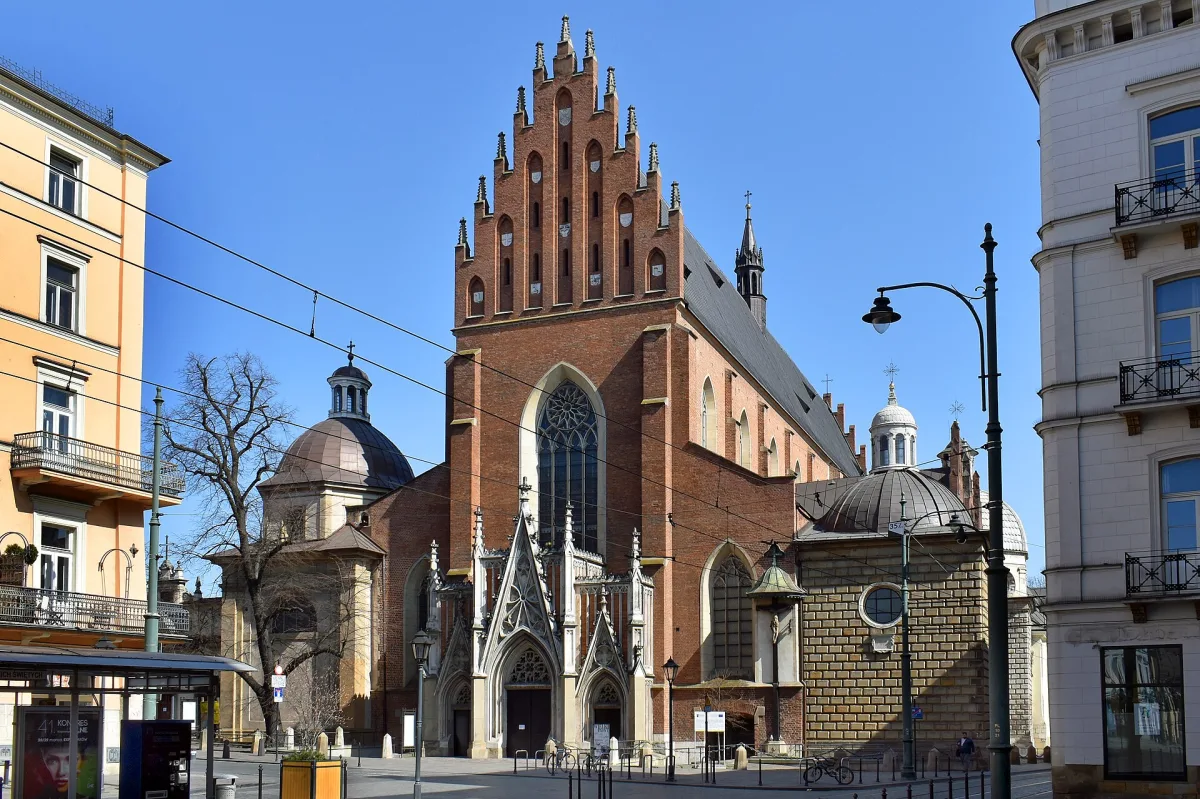
Gothic minor basilica of the Dominicans on Stolarska, rebuilt after the fire of 1850, with the Zbaraski and Rosary chapels and the Dominican Museum.
Holy Trinity Basilica at Stolarska 12 is a Gothic Dominican church in Kraków's Old Town, joined to the monastery. It is a double sanctuary: of Our Lady of the Rosary and of St Hyacinth Odrowąż. It has held the dignity of a minor basilica since 1957, and according to the heritage register it is a brick monument in the Gothic style.
The Dominicans arrived from Bologna in 1222, brought by Bishop Iwo Odrowąż. They received a parish church under the invocation of the Holy Trinity, consecrated on 12 March 1223. After the Mongol invasion of 1241, construction of a new Gothic church and monastery began.
In 1850 the roof and interior burned, the vault of the nave collapsed, and only some of the chapels survived. The reconstruction was led by the architect Teofil Żebrawski in 1853-1884. In 1855, during the work, part of the vault collapsed. The church was consecrated again in 1884, which is why its present appearance combines Gothic with neo-Gothic. In 1876 a neo-Gothic porch was added, sheltering a Gothic portal from the 14th century.
It is a three-aisled brick-and-stone church in the Kraków pier-and-buttress system, with an elongated chancel closed by a straight wall. The high altar is neo-Gothic, designed by Marian Pavoni. The organ from 1890 was made by the Rieger brothers of Jägerndorf, has 30 stops and is regarded as a valuable example of Romantic organ building.
The chapels draw attention. The Zbaraski Chapel from 1628-1633 has an interior of black marble and an elliptical dome. The Rosary Chapel from 1685-1688 was built on a Greek cross plan, and since 1983 Teofila and Marek Sobieski have been buried there. The Myszkowski Chapel from 1614 stands out for its rustication, and in the Chapel of St Hyacinth, with an altar by Baltazar Fontana from 1695-1703, lie the saint's remains.
Buried in the church are, among others, Prince Leszek the Black (d. 1288), the humanist Filippo Buonaccorsi, known as Callimachus (d. 1496), to whom a bronze slab designed by Veit Stoss is dedicated, and General Jan Skrzynecki.
The monastery buildings adjoin the church on the north side and are grouped around three cloister gardens. The cloisters, known as Kraków's campo santo, have tombstones and plaques from the 16th-17th centuries. The oldest part of the complex is the Romanesque refectory built of rough stone. In 2022 the Dominican Museum opened, with paintings by Tommaso Dolabella, panels of a polyptych by the Master of the Dominican Passion, an alabaster sculpture of Our Lady of St Hyacinth from the 13th century, and incunabula.
The church is a few hundred metres from the Main Market Square, and 0.3 km away stands the Basilica of St Francis of Assisi. Nearby are also the Cloth Hall (Sukiennice) and Wawel Royal Castle.

Be the first! Add a comment.
You need to log in to add a comment.
Log in