A Gothic and Baroque minor basilica of the Franciscans from the 13th century, with polychromy and stained glass by Wyspiański.
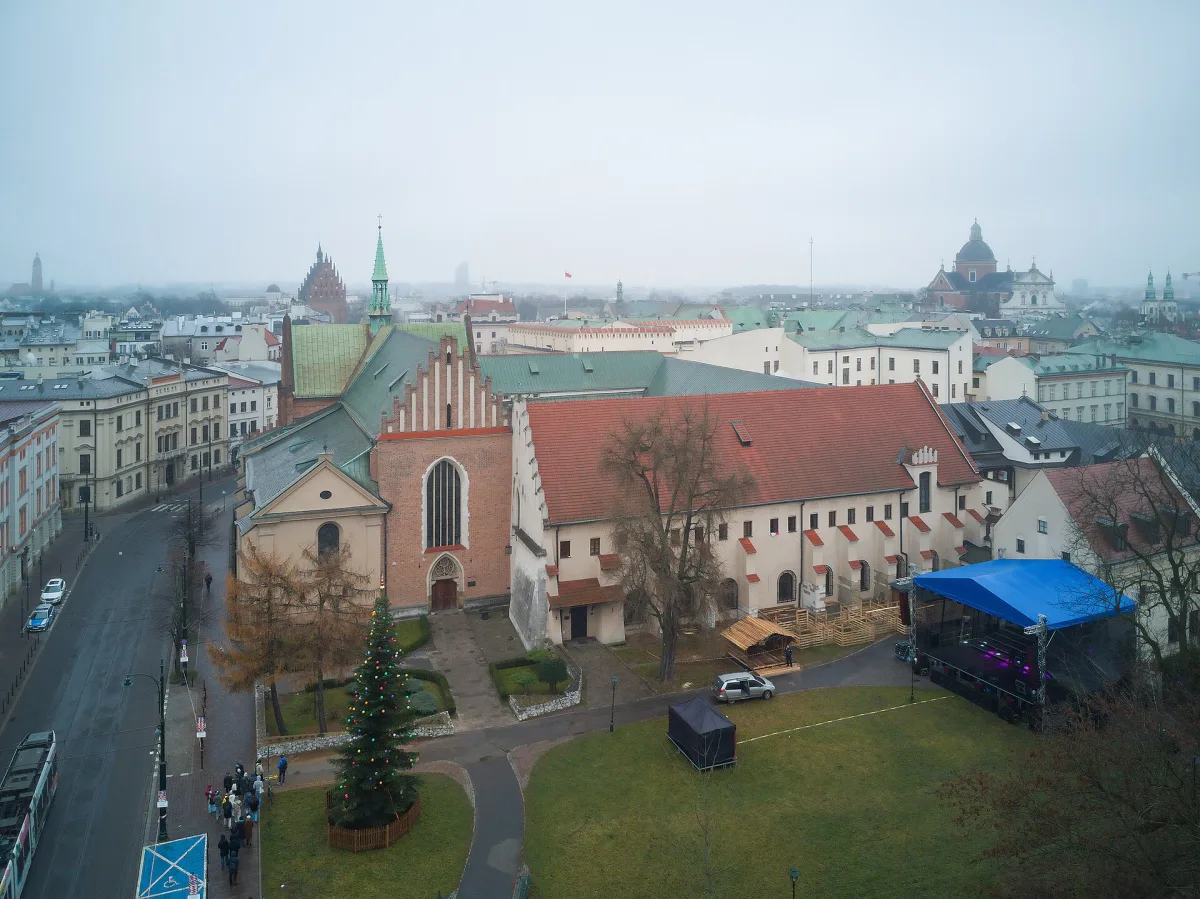
The Basilica of St Francis of Assisi is the conventual church of the Franciscans at Franciszkańska 2, at the corner of Plac Wszystkich Świętych 5. It was built in the 13th century, and since 23 February 1920 it has had the title of minor basilica, as one of the first in Kraków.
The Franciscans were brought from Prague by Duke Henry the Pious in 1236 or 1237. The church was extended around 1269, and in 1279 Duke Bolesław the Chaste and his sister Blessed Salomea were buried here. In the 15th century the chancel was lengthened and the body of the church was rebuilt as a two-aisled, asymmetrical hall. The brick building has Gothic and Baroque features.
According to the monastery's website the original church may have been built before 1269 on a Greek cross plan. During renovations in the 19th century early Gothic mouldings and tracery from the second third of the 13th century were uncovered, and on the north elevation of the transept an arcaded frieze can be seen.
Fires struck the church in 1462, 1476, 1655 and 1850, the last of which destroyed a considerable part of it.
After the fire the interiors were decorated by Stanisław Wyspiański. He made the polychrome wall paintings and four figural compositions: the Virgin and Child, Caritas, St Michael the Archangel and the Casting Out of the Rebel Angels.
Wyspiański made the polychromy from 13 June to 30 December 1895. It is an Art Nouveau decoration in pastel colours: bands of Polish flowers, including lilies, poppies, pansies and sunflowers, run through the chancel, transept and nave. The vault of the chancel is covered with hundreds of golden stars, and in the chancel there are sixteen Piast eagles. On one of the compositions the Virgin wears Kraków folk dress.
Wyspiański made the stained glass in 1897-1902, and it fills the entire window openings without division into small panes. In the chancel windows are the figures of St Francis receiving the stigmata and of Blessed Salomea with lilies, and the four elements: water is irises and water lilies, fire is burning logs and blue and yellow flames. In the west window of the main nave, above the choir, is placed the stained glass God the Father - Let It Be, also known as Fiat. Scenes from the life of St Francis were painted by Tadeusz Popiel.
The high altar was made in 1861 by Edward and Zygmunt Stehlik, with Gerhard Flatz's painting The Glory of St Francis. A slab from 1871 to a design by Jan Matejko depicts Bolesław the Chaste. In the Chapel of the Passion hang fourteen oil paintings of the Stations of the Cross by Józef Mehoffer from 1930-1946, showing Christ in a short, ragged tunic, and in the Chapel of Our Lady of Sorrows a miraculous image crowned in 1908. The church is a triple sanctuary: of Our Lady of Sorrows, of Blessed Salomea of the Piast dynasty and of Blessed Aniela Salawa.
Late Gothic wall paintings have survived in the cloister. In the west wing there is a triptych from around 1523 with the Virgin and Child, a composition of the Mystic Winepress made after 1436, a scene of the stigmatisation of St Francis from 1440-1450 and an Annunciation from 1430-1436. The gallery of portraits of the bishops of Kraków has 35 paintings on panel and canvas, including Karol Wojtyła as John Paul II, and of the former 34 frescoes 13 have survived.
The miraculous image of Our Lady of Sorrows of Kraków is a late Gothic panel painting from around 1510, attributed to Master George or his circle: Mary pierced by a sword against a golden background, surrounded by four angels with the instruments of the Passion. In the Chapel of the Passion, since 2003, stands a copy of the Shroud of Turin measuring 4.36 by 1.10 m, in a glass sarcophagus designed by the architect Anna Zabdyr-Jamróz.
Every year the Franciscan monastery puts on a living nativity scene, with concerts, nativity plays and carol singing from Christmas Eve night. Since 1595 the Archconfraternity of the Passion has operated here.
On the other side of the square stands the Church of Saints Peter and Paul, and about 300 m further the Cloth Hall (Sukiennice). It is about 500 m to Wawel.

Be the first! Add a comment.
You need to log in to add a comment.
Log in