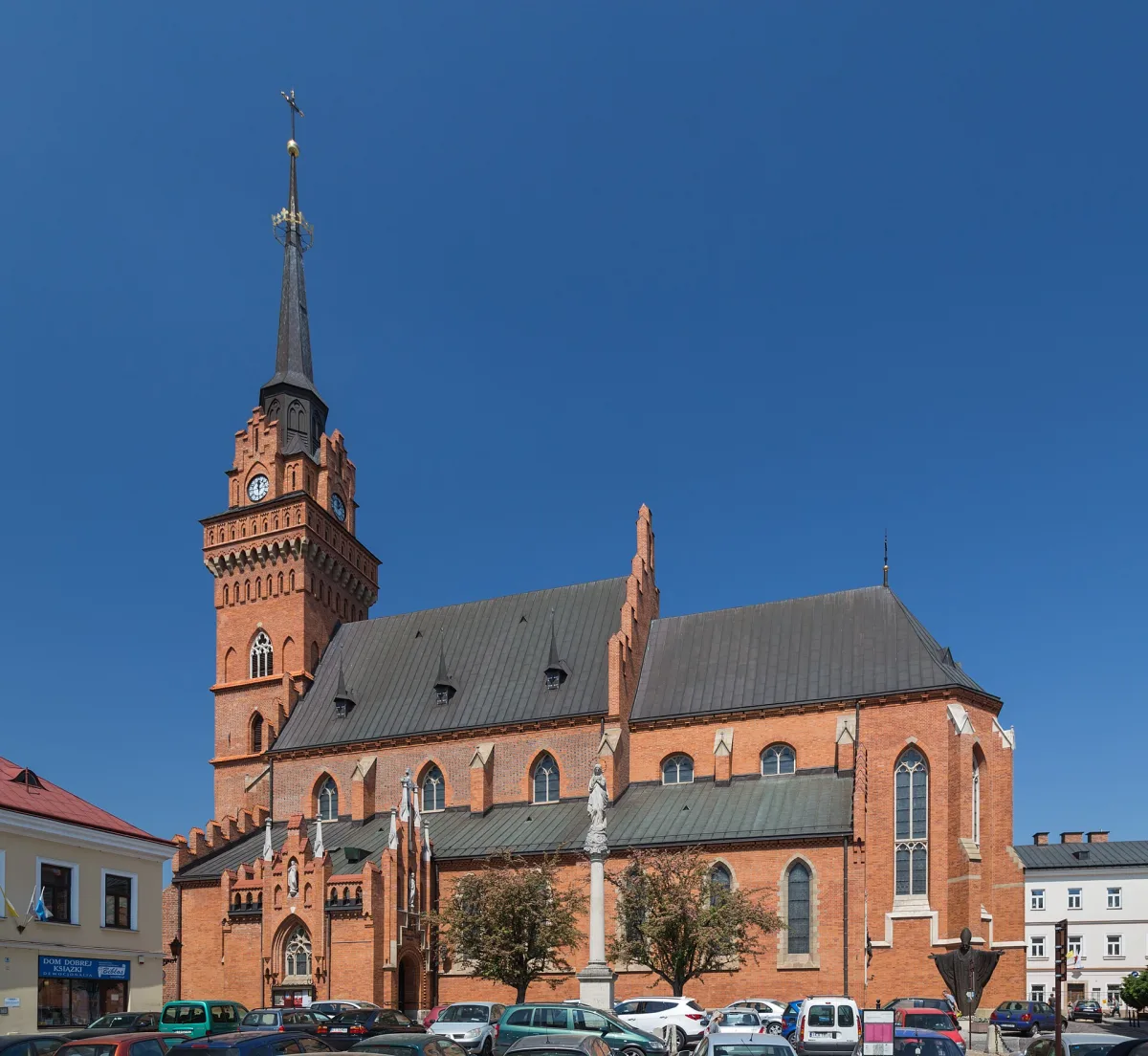
A cathedral of the Tarnów diocese, Gothic in origin and neo-Gothic in appearance, with a tower 72 metres high and Renaissance tombs of the Tarnowski and Ostrogski families.
The cathedral basilica in Tarnów stands on Katedralny Square and is the main church of the Tarnów diocese and a shrine of Our Lady of Sorrows. It began as a Gothic parish church and today has a neo-Gothic appearance and a tower 72 metres high, visible from afar above the Old Town.
The parish was founded with the town's charter in the mid-14th century, and the first church dates from around the middle of that century. Fires in 1483 and 1494 forced rebuilding. In 1400 Bishop Piotr Wysz raised it to the rank of collegiate church. The Tarnów diocese was created in 1783 by Emperor Joseph II, and Pope Pius VI confirmed it on 13 March 1786. The church received the title of minor basilica from Paul VI on 14 June 1972.
It is a three-nave building with an elongated chancel closed by a three-sided apse, built of brick with stone details and with roofs covered in copper sheet. It was given its basilica layout in 1827-1832, and the neo-Gothic reconstruction was carried out in 1890-1899. At that time the tower was rebuilt to a height of 72 metres to a design by Julian Zachariewicz of Lviv, under the direction of Ignacy Łobos. The spire is topped with a gilded crown from 1898.
The most valuable items inside are the monumental tombs in the chancel. The monument to Hetman Jan Tarnowski from 1561-1573 was made by Giovanni Maria Padovano and is about 13 metres high. The tomb of Janusz Ostrogski and Zuzanna Serédi from 1612-1620 is the work of Jan Pfister, about 12.9 metres high. There are also the tomb of Zofia Tarnowska Ostrogska, made of Italian marble, and the Gothic-Renaissance monument of Barbara of Rożnów, made of white sandstone.
The nave has a net vault from 1494, and along the aisles there are chapels, among them the Holy Cross chapel from the 14th century and the Our Lady of the Scapular chapel from 1514. The organ has 40 stops, three manuals and a pedalboard.
The aisles were created in the mid-19th century by joining older chapels. Their origins go back to the Middle Ages: the Holy Cross chapel dates from the second half of the 14th century, the Dispersion of the Apostles chapel from 1415, the St Anne chapel from 1512, the Our Lady of the Scapular chapel from 1514, and the Holy Relics chapel, with a dome, from 1712. In the south aisle stands the altar of Our Lady of Sorrows with a wooden Pietà from the 17th century and fragments of polychromy from 1514-1526. The nave has a neo-Gothic pulpit from 1894 and neo-Baroque side altars from 1850. The organ from 1920 was modernised in 1965 and in 1999-2000.
Beneath the cathedral are seven crypts, including the family crypts of the Tarnowski and Ostrogski families and the crypt of the bishops of Tarnów. In front of the church stands a monument to John Paul II from 1981. Since 1987 round-the-clock adoration of the Blessed Sacrament has been held in the cathedral.
Next to the cathedral are the Diocesan Museum and the Museum of the Tarnów Region, and a few hundred metres away the Ludwik Solski Theatre and the New Synagogue. Close by is also the Church of the Holy Cross and St Philip Neri.

Be the first! Add a comment.
You need to log in to add a comment.
Log in