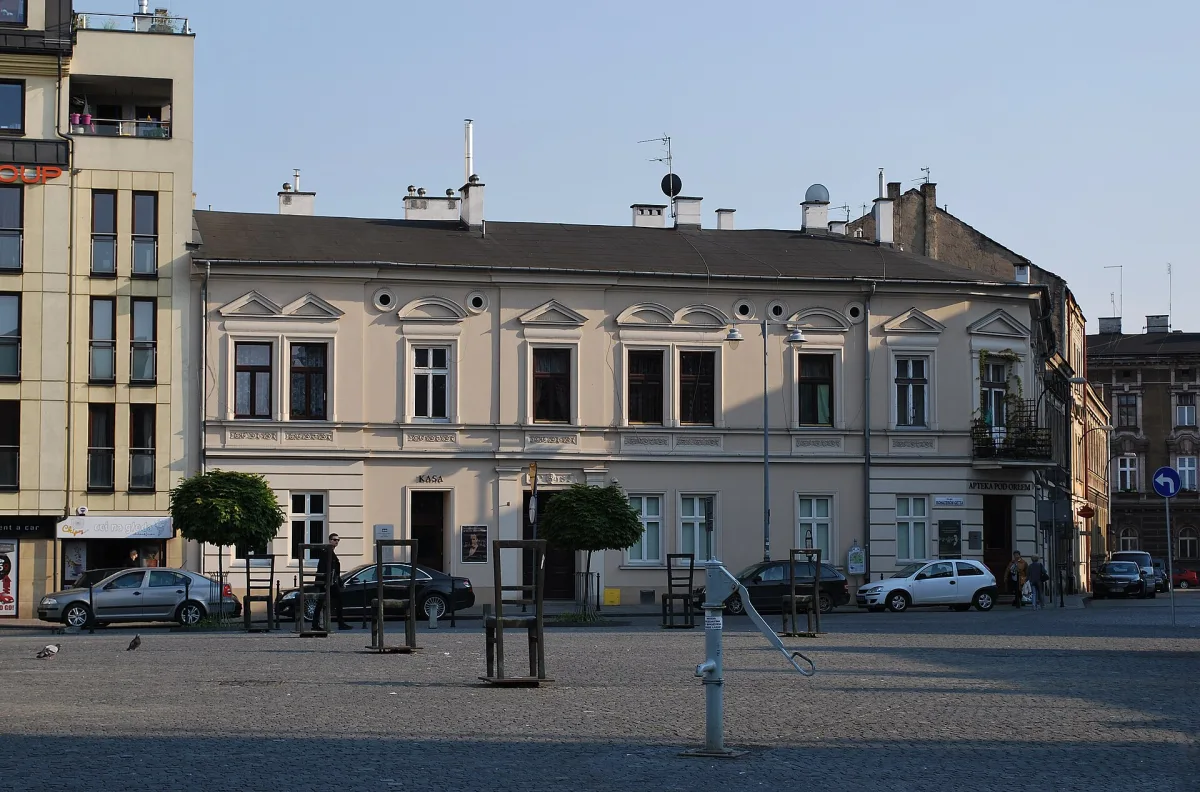
A branch of the Museum of Kraków in the former pharmacy of Tadeusz Pankiewicz, the only one operating in the Kraków ghetto, with a permanent exhibition on life in the ghetto.
The Eagle Pharmacy (Apteka Pod Orłem) is a branch of the Museum of Kraków at Plac Bohaterów Getta 18 in Podgórze. During the German occupation it was the only pharmacy in the Kraków ghetto, and its manager was Tadeusz Pankiewicz, the only Pole who lived within the ghetto boundaries from its beginning to its end. Today these premises house a permanent exhibition about the pharmacy and about life in the ghetto.
The pharmacy was founded in 1909 by Józef Pankiewicz, Tadeusz's father, at Mały Rynek 18. The square was later renamed Plac Zgody, and today it is Plac Bohaterów Getta. Tadeusz Pankiewicz worked there from 1930 and ran it from 1934, after completing pharmacy studies at the Jagiellonian University. He became the formal owner in 1946.
The ghetto was established in Podgórze in 1941. The pharmacy found itself in the part known as ghetto B, intended for the unemployed, the elderly and the sick. On the orders of the German authorities it remained open around the clock. It was staffed by Irena Droździkowska, Aurelia Czort and Helena Krywaniuk, who had passes and left the ghetto in the evening.
According to Wikipedia, the pharmacy served functions beyond selling medicines. From December 1941 it took over the tasks of the closed post office, and it was a point of contact with the part of the city outside the ghetto and a place of help for residents. Visitors included the singer Mordechaj Gebirtig, the painter Abraham Neuman and the physician Julian Aleksandrowicz. After the liquidation of the ghetto, Pankiewicz helped prisoners of the Płaszów camp. He described his experiences in the book "The Pharmacy in the Kraków Ghetto".
After nationalisation in 1951 the pharmacy operated as Social Pharmacy no. 31, and Pankiewicz managed it until December 1953. In 1967 the business was moved to the building at Plac Bohaterów Getta 11, and a bar was opened in the former premises. In 1981 its closure was ordered, and on 22 April 1983 the Museum of National Remembrance was opened here. Since 2003 it has been a branch of the Historical Museum of the City of Kraków, today the Museum of Kraków.
The current permanent exhibition, opened on 16 March 2013, is entitled "Tadeusz Pankiewicz's Pharmacy in the Kraków Ghetto". According to the museum, it tells the story of the establishment, functioning and liquidation of the ghetto, presents the accounts of survivors and discusses the anti-Jewish decrees of the occupier. Among the interiors, Wikipedia mentions the dispensing room, the compounding room and Tadeusz Pankiewicz's room.
The pharmacy is part of the Museum of Kraków's Memory Trail. Together with it, the trail comprises Oskar Schindler's Enamel Factory and Pomorska Street. Half a kilometre away is the Museum of Contemporary Art in Kraków. The history of Kraków's Jews is complemented by a visit to the Old Synagogue in Kazimierz.

Be the first! Add a comment.
You need to log in to add a comment.
Log in